If There Was a Class Called "How to Build Yourself"
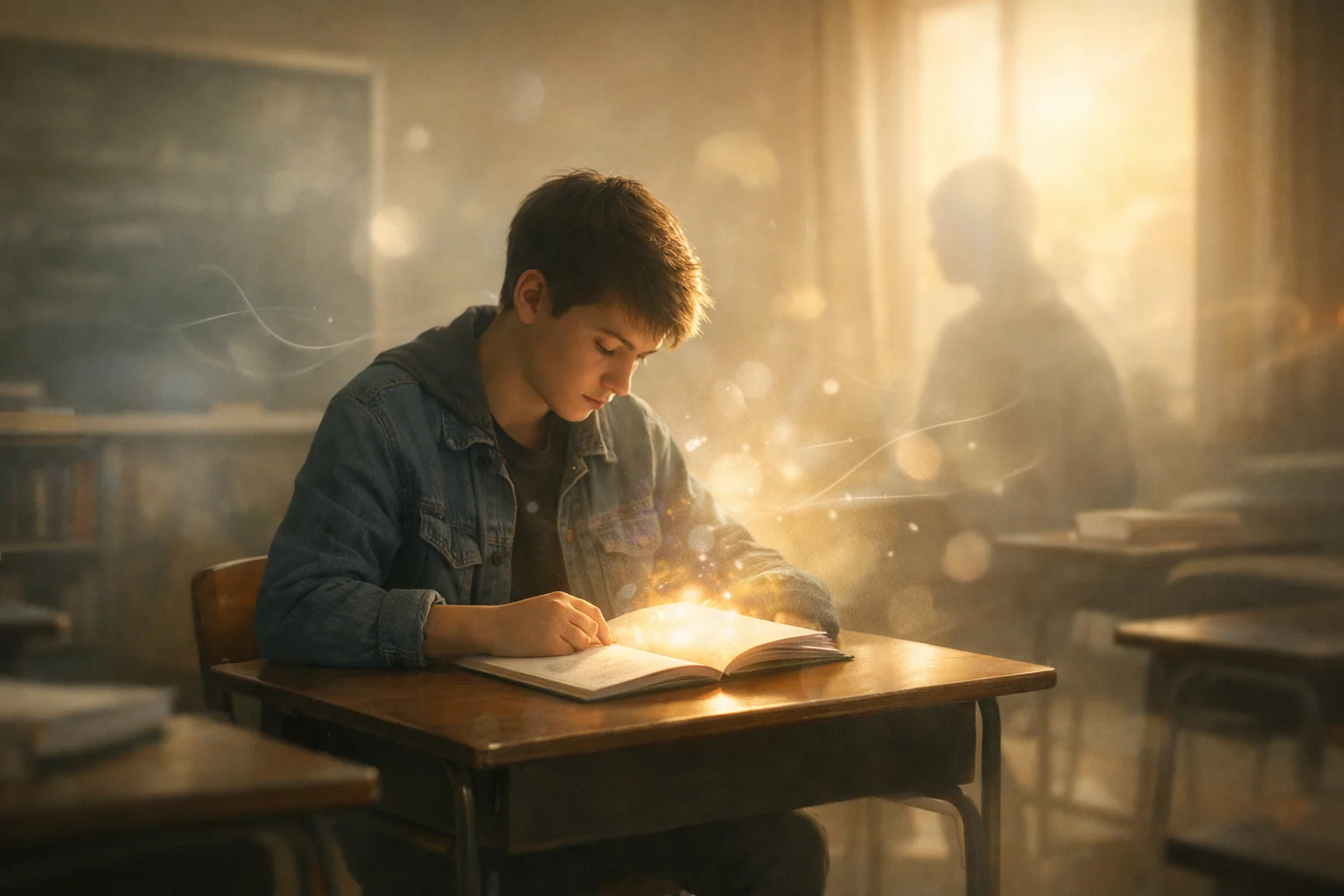
The Question We Never Ask in Schools
Imagine a class at school where, instead of wrestling with definitions and timelines, you wrestle with questions that really matter: Who am I? What do I want? What am I afraid of? What do I deserve? What makes me happy? How do I make decisions? How do I hear my own voice among thousands of others?
Imagine a class where you are not graded on tests, but on how honest you are with yourself. Where the teacher doesn't ask, "What do you remember?" but "What did you discover about yourself today?" Where the textbook is your own life, and the homework is paying attention to the way you feel when no one is watching.
If there were self-awareness classes in schools, we would raise a generation that starts life from a fundamentally different foundation, not one built on fear, comparison, and external validation but on awareness, inner balance, and personal truth.
The Cost of the Gap
Today, most adults spend their formative decades trying to figure out who they are, often through wrong choices, exhausting paths, and dead ends. Not because they want to make mistakes, but because they were never given the space, or the time, to discover themselves when they were still children.
The data paints a grim picture. Nearly one in five adolescents aged 12 to 17 experiences a major depressive episode in a given year, roughly 4.5 million teenagers in the United States alone. Among high school students, 40% report persistent feelings of sadness or hopelessness. In 2021, the U.S. Surgeon General took the extraordinary step of declaring youth mental health a national crisis, not as speculation but in response to emergency department visits for mental health among teens rising by 31% in a single year. Perhaps most revealing of all: among adolescents who did experience a major depressive episode, 40% still received no mental health care whatsoever. The most common reason they gave? They believed they should be able to handle their problems on their own, a belief that speaks volumes about what we do and do not teach children about their inner world.
A 2025 study published in Frontiers in Psychiatry confirmed that the surge in youth mental illness over the past two decades is not simply a product of better awareness or diagnostic practices. It reflects a genuine public health crisis, one rooted in a society that has systematically prioritized cognitive achievement over emotional development. We grew up in a world that taught us to chase grades without chasing our needs. To memorize material without understanding ourselves. We were taught to prepare for exams, but not for life.
What Self-Awareness Could Build
A lesson in self-awareness would give children the opportunity to build character, not just a résumé. It would teach them to listen to their limits, to realize their value, to recognize what fills them and what empties them. It would shield them from the trap of perfectionism, from the fear of failure, from the need to satisfy others at the expense of themselves.
This is not wishful thinking. The closest thing we currently have, Social and Emotional Learning (SEL), has already produced measurable results. A comprehensive meta-analysis led by researchers at Yale, reviewing over 424 experimental studies across more than 50 countries and half a million students, found that students who participated in SEL programs performed better academically, reported less anxiety and depression, felt safer and more included at school, and developed stronger relationships with peers and teachers. The research from CASEL (the Collaborative for Academic, Social, and Emotional Learning) goes further: SEL interventions have been shown to boost academic performance by an average of 11 percentile points, with lasting effects that persist years later, a 13-percentile-point advantage even long after the program ends. And the return on investment? For every dollar invested in evidence-based SEL, researchers estimate an eleven-dollar return.
Yet even SEL, as effective as it is, only scratches the surface. It teaches emotional regulation and social skills, but it rarely asks the deeper questions: Who are you, underneath all the roles you play? What are you building your life around, and is it truly yours? A true self-awareness class would go beyond managing emotions. It would teach the art of understanding them, of tracing anxiety to its root, of distinguishing your own desires from those imposed on you, of learning that your worth is not determined by your output.
The Lesson No Other Lesson Dares to Touch
Such a lesson could teach something that no other lesson dares to touch: how to live with honesty. Not the social honesty of "don't lie," but the existential honesty of "don't betray who you are."
Children would learn how to make difficult decisions without underestimating themselves, how to respect their own path without constantly comparing themselves to others, and how to treat failures not as a final destination but as steps along the way. They would learn that failure is not a shame but a sign of courage, that the road of life is not a straight line but a series of circles, stops, and returns, that a person's strength is not measured by their achievements but by the way they get up when they fall.
Consider how much pain is rooted in the absence of this knowledge. The teenager who cannot say "no" because no one ever taught her that boundaries are a form of self-respect. The young man who chooses a career to please his father and spends twenty years feeling hollow. The student who ties her entire identity to grades and collapses the first time she gets a C. These are not character flaws. These are consequences of an education that never included the self.
Socrates said it over two thousand years ago: "The unexamined life is not worth living." Modern psychology has spent over a century arriving at the same conclusion. Viktor Frankl, having survived the concentration camps of World War II, concluded that the people who endured were not the physically strongest but those who had found meaning, those who had an inner compass. Carl Rogers, one of the founders of humanistic psychology, built an entire therapeutic framework around the idea that most human suffering stems from a disconnection between who we truly are and who we believe we must be. These are not abstract philosophical positions. They are insights backed by decades of clinical evidence, and they point toward the same truth: knowing yourself is not a luxury. It is a necessity.
The Society We Could Create
Imagine then what society would be like: fewer people trapped in wrong choices for decades, more people standing on their own two feet from an early age. Fewer adults are settling for jobs, relationships, and roles that do not express them; more people are daring to seek what they really want. Less fear, more self-awareness. Fewer decisions made out of obligation, more out of conscience.
The research supports this vision at every level. Students with stronger social and emotional skills are measurably more likely to graduate from high school, attend and complete college, obtain stable employment, and avoid criminal involvement. These are not soft outcomes — they are the hard foundations of a functioning society. And the evidence shows that such benefits hold across demographic groups, socioeconomic backgrounds, and cultural contexts in urban, suburban, and rural communities, both inside and outside the United States.
A society is built through its people, and people are built through their relationship with themselves. If that relationship changes, society changes too. When individuals understand their own emotions, they are less likely to project their unresolved pain onto others. When they know their values, they are less susceptible to manipulation. When they have practiced honest self-reflection, they bring more empathy, patience, and clarity into every interaction as parents, as colleagues, and as citizens.
The Great Paradox of Modern Education
It is impressive, and at the same time deeply sad, that we enter adulthood with so much knowledge and so little understanding of ourselves. We know what a photon is and what an aorta is, but we don't know why we can't say "no." We know how to solve equations, but we don't know how to untangle the knots we carry inside us. We know how to write essays, but we don't know how to express our needs.
The statistics tell us that approximately one in three young people aged 12 to 17 now has a mental, emotional, developmental, or behavioral concern. The average delay between the onset of mental illness symptoms and receiving treatment is eleven years. Eleven years of suffering in silence, of misdiagnosis, of trying to handle things alone — in many cases, because no one ever taught these children that paying attention to their inner life is not weakness but wisdom.
If there were a class that taught us how to treat ourselves with kindness, maturity, and truth, then perhaps we would have less mental exhaustion, less corrosive self-criticism, and less shame. And more life. More capacity for joy. More resilience is not born from hardness, but from a deep and steady knowledge of who we are.
Building the Class Ourselves
This lesson does not yet exist in most schools, though the movement toward it is growing. More than half of U.S. states now have learning standards for social and emotional development. Organizations across the globe are developing curricula that bridge the gap between emotional intelligence and self-knowledge, aiming to equip students with essential skills for personal and academic success. Over 80% of parents whose children receive SEL instruction say they want the school to maintain or increase its presence.
But we need not wait for institutions to catch up. This is a lesson we can begin to create ourselves, in our families, our workplaces, our relationships, and our daily lives. We can build it through conversations we are not afraid to have, through choices that honor us, through the courage to see ourselves clearly and to let others do the same.
We can teach our children that their feelings are data, not disruptions. That saying "I don't know who I am yet" is not a confession of failure but the beginning of the most important journey they will ever take. That asking for help is not a sign of weakness but a sign that they understand something many adults never learn: that no one was meant to figure this out alone.
Because in the end, the greatest work of every human being is not the house they build, nor the career they pursue, nor the achievements they accumulate. The greatest work of every human being is their whole self. And this work, the most demanding, the most luminous, the most authentic, never ends.