"Make the Soldiers Rich, and Don't Worry About Anything Else"
Power, the Army, and Money: How a Cynical Imperial Piece of Advice Led to Murders, Massive Taxation, and a State Designed to Pay Legions
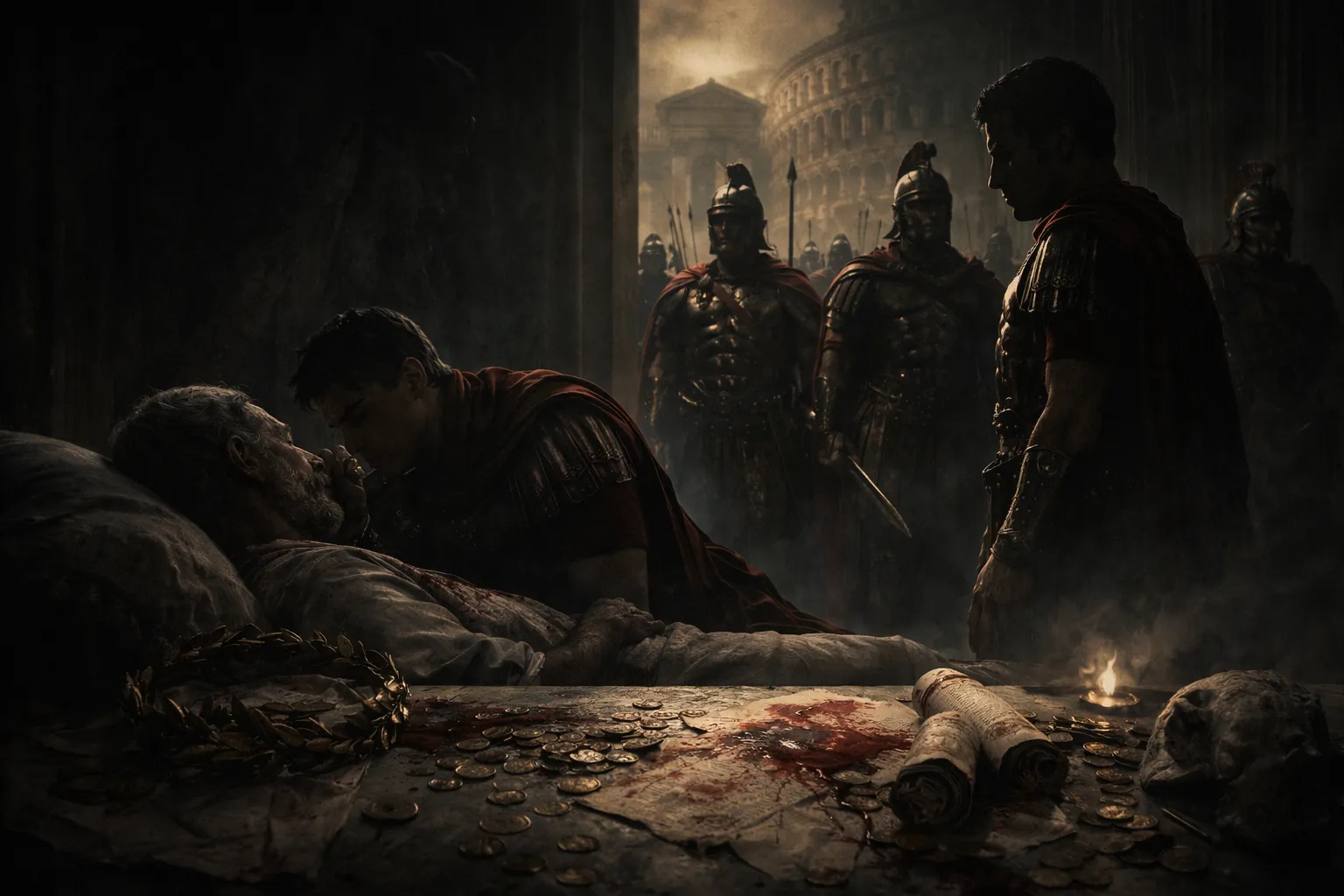
Emperor Septimius Severus lies dying in distant Eboracum, the garrison town we now call York. He is sixty-five years old. Born under a blinding North African sun in Leptis Magna, in what is today Libya, he will breathe his last in the freezing dampness of a British winter. He carries Punic blood from his father's line and Italian blood from his mother's, and he speaks Latin with a faint Libyan accent he never quite shed. His life has been an unbroken chain of campaigns, rebellions, political intrigues, and ruthless war for power, a life that began in provincial obscurity and climbed, through cunning and violence, to the summit of the known world.
He had seized the purple in the chaotic Year of the Five Emperors in 193 AD, when the Praetorian Guard murdered Emperor Pertinax and then auctioned the throne itself to the highest bidder, a senator named Didius Julianus, who bought the empire the way a man might buy a horse at market. Severus marched his Danubian legions to Rome, entered the city without a fight, disbanded the treacherous Guard, replaced them with his own men, and then spent years hunting and destroying his two rival claimants: Pescennius Niger in the East and Clodius Albinus in Gaul. The Battle of Lugdunum in 197 AD, where he crushed Albinus, was said to be the largest and bloodiest clash between Roman forces in living memory.
And yet, for all the violence that made him, Septimius Severus will die in his bed, the last Roman emperor for the next eighty years to have this "luxury." After him, the throne becomes a death sentence served quickly.
Shortly before he passes, he summons his two sons, Caracalla and Geta. He does not speak to them of virtue, of philosophy, of Marcus Aurelius, whose name he had cynically adopted to legitimize his dynasty. He does not speak of the Senate, or the laws, or Rome as an idea. The historian Cassius Dio, a contemporary and a senator, records the words that Severus leaves as his only political testament, almost a manual on how power actually works: "Be harmonious, make the soldiers rich, and scorn all others."
The calendar reads February 4, 211 AD.
The first part of the advice, "be harmonious," was perhaps the most important and the one his sons would discard first. The second part, "make the soldiers rich," was the one they would follow to the letter and beyond. The third part, "scorn all others," was the one the empire would live by for the next century, until it nearly destroyed itself.
Severus knows exactly what he is saying. He himself had risen from the legions. He understood, with the brutal clarity of experience, that Rome was no longer ruled by institutions but by the swords and loyalty of its 33 legions, roughly 400,000 men under arms, the largest military establishment the empire had ever maintained. Whoever paid the army lived. Whoever disappointed it died. The Senate debated. The legions decided.
And Severus had paid handsomely. He had doubled legionary pay, from 300 to 600 denarii per year, the most generous raise any emperor had ever granted. He had lifted the ancient ban that forbade soldiers from marrying during their service, allowing legionaries to take wives and raise families near their camps. He had created three entirely new legions, the I, II, and III Parthica, and stationed one of them, the II Parthica, just outside Rome at Alba, a constant and not-so-subtle reminder of where real power resided. He had restructured the Praetorian Guard, filling its ranks not with pampered Italian volunteers but with battle-hardened men promoted from the frontier legions. The military budget now consumed an estimated 40 to 50 percent of the empire's total expenditure even in peacetime.
By the end of his reign, the Roman Empire stretched across more than 5 million square kilometers — what some scholars consider its greatest territorial extent — and the army had become the single most important institution in the Roman world. Not the Senate, not the law courts, not the temples. The army.
This was the world he bequeathed to his sons.
Fratricide as a Political Program
Caracalla and Geta were twenty-three and twenty-two years old when their father died. They had loathed each other for as long as anyone could remember. Even during the Scottish campaign, while Severus fought the Caledonian tribes with an army of 50,000 men, the brothers had to be kept apart, Caracalla with the army, learning war; Geta in York with their mother, Julia Domna, learning administration. Their rivalry was not sibling bickering. It was a structural crisis: two emperors, one throne.
After Severus's death, both brothers were proclaimed co-emperors, as their father had wished. They returned to Rome together, but the journey itself was a portrait of mutual hatred. They refused to lodge in the same house or share a single meal. Once in the capital, they physically divided the Imperial Palace, each brother occupying a separate wing, each surrounded by his own guards, each terrified of the other. They met only in the presence of their mother, and only with armed men flanking them.
There was even a proposal, reportedly discussed in earnest, to divide the empire in two, Caracalla would take the West and Geta the East. Their mother Julia Domna is said to have killed the idea, recognizing that such a partition would not bring peace but civil war on a continental scale.
Caracalla showed that he had learned his father's lesson, but in the most brutal way possible. In late December 211 AD, he arranged a meeting with Geta under the pretense of reconciliation, set in the private apartments of their mother. Geta came unarmed and unguarded. When he entered the room, centurions loyal to Caracalla burst through the door and cut him down. Geta bled to death in Julia Domna's arms. The blood of her youngest son splattered on the imperial purple.
This was not a personal outburst, not the uncontrollable rage of a young man. It was a calculated political act, a message about what kind of reign was to follow. Caracalla then rushed to the Praetorian barracks and told the soldiers that Geta had conspired against him and that the killing was self-defense. The praetorians had sworn loyalty to both emperors. But Caracalla knew exactly how to secure their silence: he paid each guardsman a bonus of 2,500 denarii and raised their ration allowance by 50 percent.
Then came the purge. What followed Geta's murder was not just a settling of scores; it was a systematic liquidation. Approximately 20,000 people were killed: Geta's inner circle of guards and advisors; his friends, senators, and intellectuals who had shown him favor; military staff under his command; equestrians; provincial governors; ordinary soldiers, and even the charioteers of the racing faction Geta had supported. The historian Cassius Dio, who lived through these events as a senator, left a numbed catalog of the dead.
And then Caracalla went further. He ordered something the Romans called "damnatio memoriae," the damnation of memory. Geta's name was chiseled from every public inscription across the entire empire. His statues were torn down. His coins were melted. His face was scraped from paintings. On the great Arch of Septimius Severus, still standing in the Forum today, you can see where Geta's name once appeared, replaced by the hollow phrase: Optimis Fortissimisque Principibus, "to the most excellent and strongest of princes." Even the word "et," which had once joined the brothers' names, was erased and replaced with PP, "Father of the Fatherland." The famous Severan Tondo, a painted family portrait, survives with one face violently obliterated, Geta's.
Rome learned the old rule once more, written in fresh blood: power is not to be shared.
"Pay Them. All of Them."
Caracalla, however, did not stop at violence. He understood something his father's deathbed advice had made explicit: legitimacy does not come only from fear. It comes from money. And so the very first thing he did after securing the throne was open the imperial coffers wide.
He distributed to the army an amount reported to be equal to everything Septimius Severus had accumulated in all the imperial treasuries over his entire eighteen-year reign. It was a spectacular, almost suicidal act for public finances, but it was entirely consistent with his father's political testament. He then raised legionary pay by a further 50 percent, from the 2,400 sestertii his father had established to 3,600 sestertii per year. According to Cassius Dio, this single pay raise cost the Roman state an additional 70 million denarii annually, a staggering sum that represented a permanent structural increase in military expenditure. He also raised the praetorians' pay and the discharge bonus for veterans, which climbed from 3,000 to 5,000 denarii.
He told his soldiers, in words recorded by the ancient sources: "I am one of you, and it is because of you alone that I care to live, in order that I may confer upon you many favors, for all the treasuries are yours."
The legions adored him.
But adoration has a price, and the treasury was bleeding.
Taxes, Not Ideas
The coffers emptied quickly. Caracalla was not an administrator; he was a spender, a campaigner, a raider of treasuries. But he understood something fundamental that many rulers throughout history have grasped only too late: to pay armies, you need revenue. And here he showed a crude, almost modern economic intelligence, the instinct of a man who could not balance a ledger but who grasped, with animal clarity, where the money was.
Roman citizens had long been subject to certain taxes from which non-citizens were exempt. Chief among these was the vicesima hereditatium, the inheritance tax, originally set at 5 percent by Augustus and applied to all bequests above a certain threshold. Only Roman citizens paid it. Non-citizens, the vast majority of the empire's population, the millions of peregrini who lived in the provinces from Syria to Britannia, and from Egypt to Hispania, were outside its reach.
Caracalla saw the opportunity, and he took it with breathtaking directness.
In 212 AD, he issued the Constitutio Antoniniana, the Antonine Constitution, a decree that went down in history as one of the most consequential legal acts the Roman world ever produced. In a single stroke, he granted Roman citizenship to virtually all free men and women throughout the empire. The only people excluded were a marginal legal category called the dediticii, former enemies of Rome who had surrendered unconditionally, and certain disgraced freedmen.
The ancient historian Cassius Dio was blunt about the motivation: Caracalla wanted to increase the number of people liable to pay citizen-only taxes, especially the inheritance tax, which he had also raised, possibly doubling it to 10 percent. Overnight, millions of new citizens became subject to the vicesima hereditatium and to the vicesima libertatis, the tax levied on the manumission of slaves. The tax base expanded not by a fraction but by an order of magnitude.
The edict's preamble, preserved on a damaged Egyptian papyrus now in Giessen, Germany, the Papyrus Giessen 40, frames the decree in pious language, thanking the gods for delivering Caracalla from danger (a veiled reference to the conspiracy that, in his telling, justified Geta's murder). The new citizens, the papyrus says, would "bear all the burdens of being a citizen, but share in the victory as well." The "burdens" were the taxes. The "victory" was the legal status that came with them.
Was there idealism in this act? Perhaps a trace. Universal citizenship did simplify legal administration, promote a sense of common Roman identity, and dismantle one of the last formal barriers between the Italian core and the provincial periphery. The millions of newly enfranchised people adopted the emperor's family name, Aurelius, as their own, a phenomenon visible in inscriptions and papyri across the empire for decades to come. Seven of the eleven emperors between Gallienus and Diocletian would bear the name Marcus Aurelius, a lasting echo of that single decree.
But the driving logic was fiscal, not philosophical. Citizenship ceased to be an honor earned through service or granted as a mark of distinction. It became a tax instrument.
The Antoninianus and the Debasement
Even the expanded tax base was not enough. Caracalla's military expenditures were relentless, and they required more than what the traditional fiscal machinery could deliver. So he turned to the other ancient expedient of emperors who needed money they did not have: he debased the currency.
He introduced a new coin, the antoninianus, named after his official title, Marcus Aurelius Antoninus. It was presented as a double denarius, nominally worth two of the traditional silver coins. But it contained only about one and a half times the silver of a single denarius. The trick was transparent: the state paid its soldiers and suppliers with coins whose face value exceeded their metal content. It was inflation by decree — a stealth tax on everyone who held money.
Under Caracalla, the silver content of the denarius itself was reduced to around 50 percent purity, down from the roughly 80 percent that had been standard under Marcus Aurelius just a few decades earlier. This debasement, combined with the massive military pay increases, set in motion the inflationary spiral that would torment the Roman economy for the rest of the third century. Caracalla's successor, Macrinus, tried to claw back some of the pay increases but was overthrown within a year, the army would not tolerate a reduction. The lesson was clear: once military pay goes up, it never comes down.
By the mid-third century, the empire would be trapped in a vicious cycle: pay increases were necessary to secure loyalty, but the currency base could not support them, leading to spiraling debasement, rising prices, and yet more demands for higher pay.
Blood and Marble: The Baths of Caracalla
Caracalla is also remembered for something that still stands, in magnificent ruin, on the Aventine slope in the southern part of Rome: the Baths of Caracalla, the Thermae Antoninianae.
Begun under Septimius Severus around 206 AD and inaugurated by Caracalla in 216 AD, with finishing work continuing under his successors Elagabalus and Severus Alexander until about 235 AD, they were the second-largest public bathing complex in all of Roman history, surpassed only by the later Baths of Diocletian. The central bathing block alone covered an area of roughly 230 by 115 meters, and the entire complex, including gardens, exercise grounds, and perimeter structures, sprawled across approximately 25 hectares, an area larger than many medieval cities.
The baths could accommodate some 1,600 bathers simultaneously, with a daily capacity estimated between 6,000 and 8,000 visitors. They were free and open to the public, rich and poor alike entered through the same doors. Inside, bathers moved through the traditional sequence of Roman bathing: the frigidarium (cold room), with its soaring vaulted ceiling and granite columns; the tepidarium (warm room); and the caldarium (hot room), a circular chamber heated from below by a vast hypocaust system that burned wood and coal beneath the marble floors. A dedicated aqueduct, the Aqua Antoniniana — a branch of the great Aqua Marcia — supplied the complex, feeding an enormous cistern divided into eighteen compartments with a total capacity of 80,000 cubic meters of water.
But the baths were far more than plumbing. They contained libraries, one Greek and one Latin. Gymnasiums. Gardens. Mosaic floors of extraordinary intricacy. More than 120 sculptures, many of monumental scale, including the famous Farnese Hercules, a 3-meter colossus that now resides in the Naples Archaeological Museum, and the Farnese Bull, the largest single sculptural group to survive from antiquity. The walls were sheathed in polychrome marble imported from quarries across the empire: from Egypt, from Asia Minor, from North Africa. The ruins still soar to heights of 40 meters, 130 feet, open to the sky, their broken vaults framing the Italian heavens.
They were monuments to power but also to excess, perfectly mirroring the nature of the authority that built them. Behind the marble and the mosaic lay taxes, massacres, and an army that had learned to be paid for its loyalty. The Baths remained in operation for more than three centuries, until the Ostrogoths severed the aqueducts during their siege of Rome in the 530s. In the 5th century, they were still counted among the Seven Wonders of Rome.
The Soldier-Emperor's End
Septimius Severus died in his bed. His son Caracalla was not so fortunate.
On April 8, 217 AD, just six years after murdering his brother, Caracalla was traveling along the road from Edessa to Carrhae, in what is now southeastern Turkey. He was on campaign against the Parthian Empire, pursuing a long-held ambition to emulate Alexander the Great, whose memory he had begun to worship with unsettling intensity. That day, he was heading to visit a temple of the moon god Sin near Carrhae, the same desolate plain where, in 53 BC, Marcus Licinius Crassus and seven Roman legions had been annihilated by the Parthians.
Caracalla dismounted from his horse to relieve himself by the roadside. A soldier named Julius Martialis, a man with a personal grudge, reportedly passed over for promotion to centurion, approached him and drove a blade into his side. A Scythian bodyguard killed Martialis almost immediately with a thrown lance. But two praetorian tribunes, who were part of the conspiracy, rushed forward as if to help the fallen emperor and finished the job.
The real architect of the plot was Macrinus, the Praetorian Prefect, Caracalla's own chief of security. Macrinus had intercepted a letter warning Caracalla that his prefect might be a traitor. Realizing that his own death was imminent if he did nothing, Macrinus acted first. Three days later, on April 11, 217 AD, the legions proclaimed Macrinus emperor, the first man to hold the title who had never been a senator.
Caracalla was twenty-nine years old. He had reigned for six years. The soldiers he had so generously fed were the very ones who killed him, or rather, the ones who let him be killed. Loyalty bought with money lasts only as long as the money flows, or until a better offer arrives.
The Legacy of a Deathbed Whisper
Macrinus tried to reverse course. He attempted to reduce the extravagant military pay that Caracalla had established, at least for new recruits. Within fourteen months, he was overthrown and executed. His successor, the teenage Elagabalus, was also murdered by his own soldiers after four years. Then came Severus Alexander, who managed thirteen years, until the legions grew impatient and killed him too, replacing him with Maximinus Thrax, who promptly doubled military pay again.
This was the world that Severus's deathbed advice created: a state held hostage by its own army, where emperors were made and unmade by the legions, where the treasury existed primarily to feed soldiers, where citizenship was a tax category and coinage a tool of deception, and where the next emperor was often just the next general willing to promise higher pay.
Between the death of Severus Alexander in 235 AD and the accession of Diocletian in 284 AD, a span of forty-nine years, there were more than twenty-five claimants to the throne. Most died violently. The period is known as the Crisis of the Third Century, and its roots trace directly back to the political economy that Septimius Severus institutionalized and that Caracalla perfected: the total subordination of the Roman state to military expenditure.
The advice, however, survived. It has crossed the centuries unscathed because it describes something that has never stopped being true. When power is based on force rather than consensus, public finances become a weapon. When the army, or any other mechanism of coercion, becomes the sole recipient of state generosity, then the state ceases to be a common home and becomes a war chest. The treasury stops serving the people and starts buying the loyalty of the people with swords.
Rome learned this early. Septimius Severus whispered it to his sons in a cold room in York, nearly two thousand years ago.
And history continues to remind us of it.