Jacob: The Lion Who Rewrote the Rules
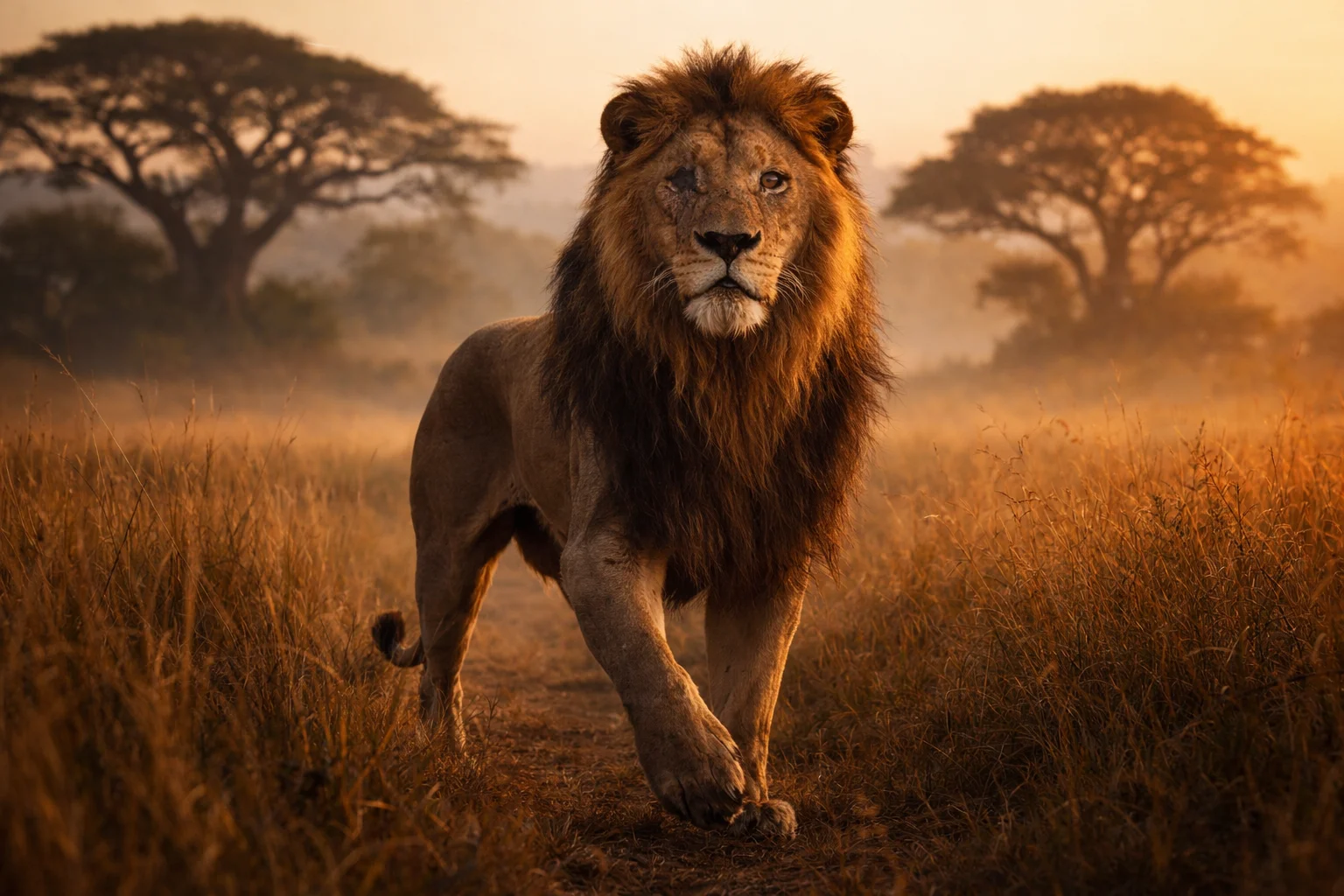
Contrary to every prediction, he managed to turn his disadvantages into advantages. It is not only humans who adapt to the circumstances life throws at them.
In the savannah of southwestern Uganda, there lives a lion that, by every measure of biology, should be dead. His name is Jacob. He is eleven years old; he has one eye, three legs, and he doesn't give a damn about what established science says he should or shouldn't be able to do.
Jacob was born around 2014 in Queen Elizabeth National Park, a 2,000-square-kilometer stretch of explosive volcanic craters, tropical forest, and open grassland wedged between Lake Edward and Lake George, connected by the broad Kazinga Channel. It is one of the most visited safari destinations on the African continent and the only Man and Biosphere savannah reserve in Uganda. It is also one of the few places on Earth where lions climb trees, sprawling across the thick branches of fig and acacia trees like oversized house cats, a behavior so unusual that it draws tourists from around the world. Jacob was one of those tree-climbing lions. Before everything went wrong, he loved to climb.
He belongs to a small, fragile population of roughly one hundred lions, a population that, according to researcher Alexander Braczkowski of Griffith University, has been halved in just five years by poaching, poisoning, and habitat pressure. Jacob lives in the crosshairs of that decline, and his body is a map of its consequences.
The Catalogue of Disasters
His ordeal began in October 2019, when, as a young lion, he stepped into a wire snare set by poachers. The steel bit deep into his left hind leg. He was lucky; a team of rangers and veterinarians from the Uganda Wildlife Authority, the Uganda Conservation Foundation, and the Wildlife Conservation Society tracked him through his radio collar, tranquilized him, cleaned the wound with antiseptic, and administered antibiotics concealed in meat. He recovered. The leg was saved that time.
Less than a year later, in August 2020, fortune ran out. Jacob wandered into neighboring Virunga National Park across the border in the Democratic Republic of the Congo, where his pride sometimes roamed. There, he stepped into a wheel trap, a steel-jawed device similar to a bear trap. He tore himself free, but the trap severed his left hind leg above the foot. He dragged himself, bleeding and broken, for days. When he finally crossed back into Uganda, a team of rangers and WCS field staff tracked him down using a handheld receiver and directional antenna connected to his collar. They found him gravely injured and exhausted. A crew of veterinarians, among them Mustafa Nsubuga of the Uganda Conservation Foundation, along with Eric Enyel and Bazil Alidria, operated on him multiple times. The wound took roughly five months to heal over. He learned to walk on three legs.
Then, six months after the amputation, poachers poisoned his pride. The killings were part of the illegal trade in lion body parts, teeth, tails, claws, and fat, sold to traditional medicine practitioners or smuggled to international markets as trophies and supposed sources of power and good luck. Jacob's family was splintered. Most of his pride was wiped out. He and his brother Tibu were left to fend for themselves.
Shortly after that, a Cape buffalo gored him during a territorial clash. The horn tore into his side, leaving his entrails hanging from his stomach, and took his right eye. A veterinarian managed to stitch him back together. He survived, again.
Snaring. Trapping. Poisoning. Goring. Four separate events, any one of which should have killed him. Braczkowski, who has tracked Jacob since 2017, put it simply: he called Jacob "the Rocky Balboa of lions" and "a cat with nine lives."
The Language of the Savannah
In the language of the savannah, a three-legged, one-eyed male lion is a dead lion walking. The arithmetic is unforgiving.
A healthy male African lion can sprint at close to 80 km/h, roughly 50 mph, in short, devastating bursts. He is a creature built for explosive power: the muscular launch, the tackle, the suffocating bite. These are the scenes from the documentaries, dramatic orchestral music, slow-motion footage of dust and sinew, and the calm, measured narration of Sir David Attenborough reminding viewers that this is nature doing what nature does.
But Jacob could no longer run. Not properly, not fast enough. His missing hind leg stole the force from his sprint. His missing eye stole depth perception, the ability to calculate distances, and the ability to judge the precise instant to lunge. Without speed and without precision, a male lion cannot hunt. And a lion that cannot hunt is a lion that starves.
According to renowned biologist George Schaller, most "tripod lions," those that lose a limb to injury, survive only with the support of their pride, relying on the kills of others, scavenging scraps, slowly diminishing. But Jacob had no pride. He had only Tibu.
So he did what we humans rarely have the courage to do. He re-evaluated. Completely.
From Bullet to Landmine
Researchers from the Kyambura Lion Monitoring Project, operating under the Volcanoes Safaris Partnership Trust and the supervision of the Uganda Wildlife Authority, spent years watching Jacob through drones and high-definition thermal cameras. What they documented, and what filmmaker Daniel Snyders captured on night footage, was nothing short of revolutionary for an adult male lion.
Jacob stopped hunting like a lion. He started hunting like a leopard.
Instead of pursuit, ambush. Instead of speed, patience. Instead of open grassland, dense scrub, thick brush, and the tangled edges of the forest. He would lie motionless for hours, hidden in the vegetation, waiting for prey to wander within striking range. Then a single explosive lunge from close quarters. No chase. No marathon sprint across the plain. One calculated strike.
He even began digging animals out of their burrows, a technique unheard of in lions but common among smaller, more resourceful predators.
And he changed his menu entirely. Instead of the traditional lion diet of large, fast, dangerous game like the antelopes and Cape buffalo that demand coordinated pride hunts and top-speed pursuit, Jacob targeted slower, more predictable prey. Animals that didn't expect a lion to bother with them. It wasn't in their evolutionary programming to fear a predator of his kind. Night footage caught him ambushing warthogs weighing up to 200 kilograms, sometimes solo, sometimes alongside Tibu, animals that most lions in the park ignored in favor of bigger game.
Simply put, Jacob switched from fast food to slow food. And he survived. Against every odd stacked against him, he persevered.
Braczkowski described the transformation with admiration: Jacob has no chance in a chase, so he changed his entire diet, takes enormous risks, and behaves more like a leopard, and it's working.
The Swim
As if reinventing his entire hunting strategy wasn't enough, Jacob then did something that stunned the scientific community.
In February 2024, he and Tibu swam across the Kazinga Channel, the broad natural waterway connecting Lake Edward and Lake George, teeming with Nile crocodiles and hippos. Previously recorded swims by African lions ranged from about ten meters to a few hundred meters at most, and some of those ended in crocodile attacks. Jacob and Tibu swam 1.5 kilometers. Nearly a mile. On three legs.
The researchers watched it happen in real time, captured on high-definition thermal drone cameras, and could barely believe what they were seeing. They observed what appeared to be something trailing the brothers, likely a hippo or Nile crocodile, during the crossing. The brothers made three attempts within a single hour before completing the crossing.
Their findings were published in the journal Ecology and Evolution, and Braczkowski declared the swim a record-breaker for the species.
The motivation, researchers believe, was not food but reproduction. The lion population in Queen Elizabeth National Park has become dangerously skewed; where a healthy population should maintain a ratio of roughly two females for every male, the park's ratio has been reversed, with twice as many males as females, because female lions are more likely to be killed by farmers retaliating against livestock predation. Jacob and Tibu had lost a fight for dominance with rival males just hours before plunging into the channel. They were swimming for mates. For a future.
Jacob continues to cross the Kazinga Channel regularly, researchers have documented him doing it up to twenty times over the past two years. Despite everything, he still covers more than a kilometer a day, an impressive feat for a lion this badly damaged.
What It Means
Anthropologists have long celebrated the single defining characteristic of Homo sapiens that allowed our species to become the dominant force on the planet: adaptability. We explored the unknown, new climates, new continents, and new altitudes, and natural selection followed suit over millennia, equipping us with the tools for survival. Intense equatorial sun? Darker skin is rich in melanin. Extreme polar cold? Shorter, stockier limbs to conserve heat. High-altitude oxygen deprivation? Larger lung capacity. We are the species that rewrites the manual.
No one expected to see this kind of cognitive flexibility in a wild animal. Certainly not in a solitary feline, a creature that, at the top of its food chain, has no natural enemies other than the loss of its own hunting ability. Lions do not need to be clever. They need to be powerful. That has been the contract for two million years of evolution.
Andrew Loveridge of Panthera, the global wild cat conservation organization, notes that many lions and other large predators lose limbs to poacher traps across Africa. Most of them die. Craig Packer of the University of Minnesota has suggested that, over time, adaptive behaviors like Jacob's could potentially spread among nearby lions, a kind of cultural transmission of survival strategy. But so far, observations show that most lions in Queen Elizabeth National Park stick to traditional targets, large, fast game, and even the park's famous tree-climbing lions maintain their own distinct methods, far removed from leopard-style tactics.
Jacob is, for now, the exception. And that exception is making ethologists deeply uncomfortable, in the most productive way. Because in East Africa, animals are under mounting pressure from habitat loss, poaching, and climate stress. Many of the old evolutionary strategies, the "good recipes" that worked for millennia, are failing. Species are disappearing. The fact that one individual recalibrated his entire behavioral repertoire, rapidly, without the benefit of genetic predisposition, without any external pressure other than the raw need to not die, is, for the scientists watching, both extraordinary and troubling.
It is extraordinary because it suggests a depth of individual behavioral flexibility in large carnivores that biology textbooks barely account for. And it is troubling because it raises a disquieting question: how many others could have adapted, if only they had been given the chance?
Still Here
Meanwhile, Jacob, the one-eyed, three-legged lion, continues to patrol his territory. He still climbs trees, even now, balancing on three limbs in the branches of the giant fig trees of Ishasha. He still crosses the crocodile-infested Kazinga Channel, looking for mates and for the future. He still hunts his way, the quiet, the ambush, the patient strike from the shadows.
His radio collar still pings. When it stops transmitting movement, the Uganda Wildlife Authority mobilizes because they have learned, more than once, that Jacob being still does not mean Jacob is finished.
Braczkowski has called him the most resilient lion in Africa. Perhaps the most resilient lion that has ever been documented. A creature that was snared, trapped, poisoned, gored, amputated, and left for dead, and responded by reinventing himself entirely.
Jacob teaches us something that no textbook, no documentary, and no amount of David Attenborough's narration has ever quite articulated this clearly: survival does not belong to the fastest, or the strongest, or the most genetically equipped. It belongs to those who have the guts to look at the wreckage of their former life and say, "Screw it," and rewrite the rules.
Jacob's story has been documented by Alexander Braczkowski and the Kyambura Lion Monitoring Project under the Volcanoes Safaris Partnership Trust, in collaboration with the Uganda Wildlife Authority, the Uganda Conservation Foundation, and the Wildlife Conservation Society. His record-breaking swim was published in the journal Ecology and Evolution (2024). His adapted hunting strategy was reported by New Scientist (2025).