Tennessee Williams: Poet of Lost Souls
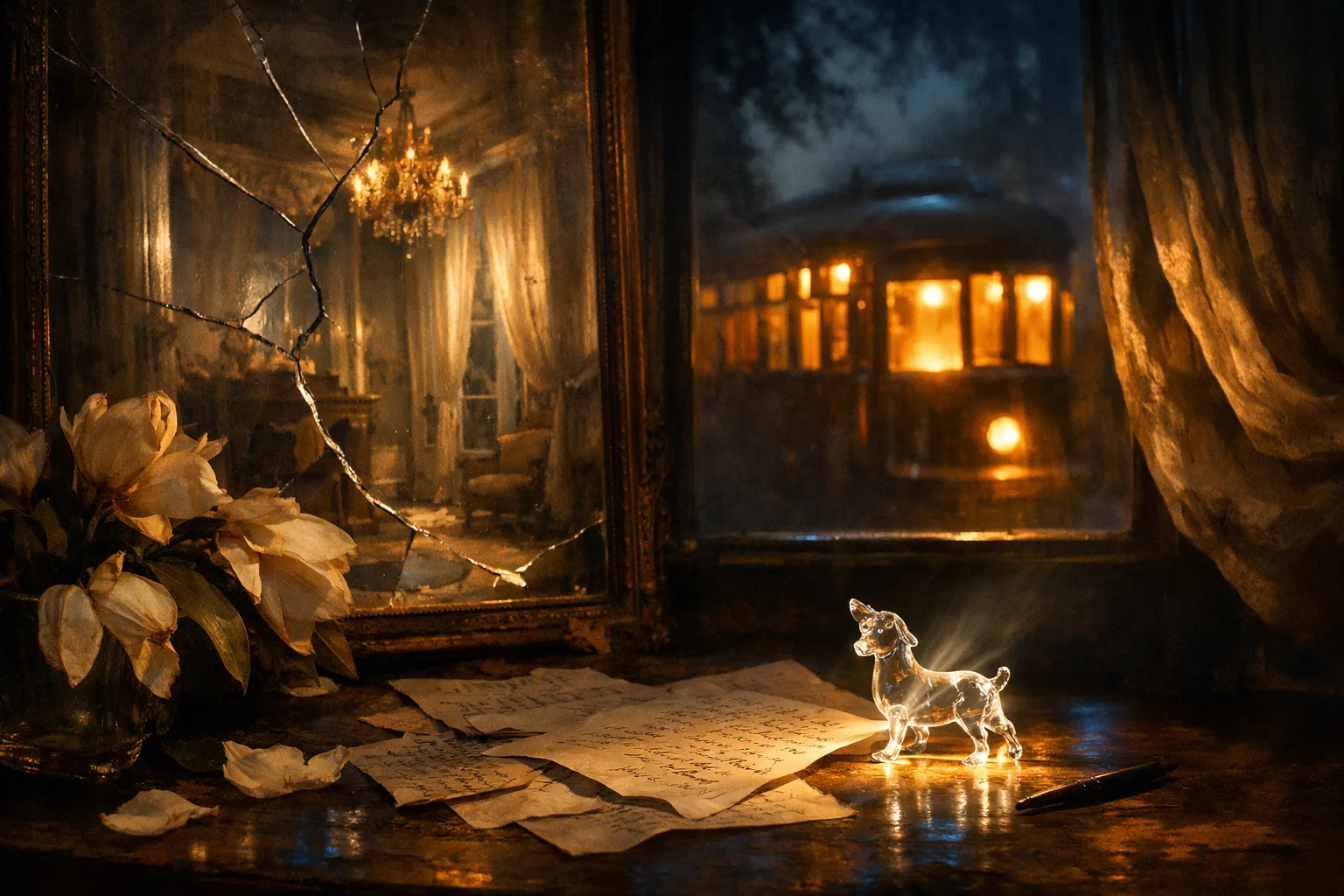
"What drives me to create theatrical characters is love," Tennessee Williams once said, adding that desire "is something that encompasses much more than a person can cover." Within that single conviction, he distilled the essence of everything he ever wrote, escape and poetry, time, life, and death.
Between 1944 and 1955, Williams produced three masterpieces that would reshape world drama: The Glass Menagerie (1944), A Streetcar Named Desire (1947), and Cat on a Hot Tin Roof (1953–1955). Alongside these stands The Rose Tattoo, written after a transformative trip to Italy in 1950, where he encountered a sun-drenched people living in easy communion with poverty and the pleasures of the flesh. That play brims with simple, unillusioned heroes who regard love as a divine gift, a striking contrast to the fragile dignity, tyrannical fantasies, and unreachable dreams that define the heroines of his three great tragedies.
Williams possessed an extraordinary gift for the psychological portraiture of women. His female characters are ravaged by turbulent passions, their nervous systems frayed, trapped in an inability to accept reality. They carry the author's own terror — his dread that he, like his sister Rose, might be driven to paranoia and madness — and the scars of a difficult childhood marked by fear of intimacy.
His women can escape neither to the mythical past they fabricate or recall, nor to the crushing present, nor to a bleak and unknown future. As Gore Vidal observed, what was extraordinary about Williams was his ability to bring the past to life, to capture it and make events transcend the limits of his original experience. This is perhaps why his work reaches us today as pure, contemporary truth, an experience conveyed on stages around the world by actors who yearn to inhabit these eternal cycles of feeling and desire.
Works That Defy Time
Scholars and ordinary viewers alike can approach Williams from perspectives as varied as their own personalities, each creating a private world through his plays, steeped in his melancholy and poetry.
"Creators, artists, are like the nervous system of an era or a country," the playwright declared. "If our nervous system is affected by the conditions that surround it, it will inevitably reflect this abnormality, sometimes indirectly and sometimes with the immediacy of violence."
His works remain enormously popular because they are an inexhaustible source of inspiration and analysis, not only for theater practitioners but also for poets, sociologists, historians, and philosophers. His legacy lives on stages and in cinemas, at festivals and in universities, from Broadway to impoverished neighborhood halls. No one leaves a Williams play unmoved; everyone recognizes some fragment of themselves in his characters.
Playwright Lillian Hellman put it best: The Glass Menagerie and A Streetcar Named Desire brought the greatest talent of the postwar generation to the theater. She believed Williams' influence would still be felt a century hence, because the mirror he held up heralded a new era, almost a new people, and that mirror would remain clear and pure.
The Wound of the American Soul
Williams dissected the wounds of the American psyche across a lifetime of writing, from his first published piece at seventeen to his last at seventy. With vivid, fluid narration, he painted the depressing loneliness of Americans, characters surrendered to isolation, drifting toward bitter disappointment. As the critic Marios Ploritis wrote, in this awareness of misery, Americans find no consolation; their individualistic society leaves the person free yet indifferent to them, and loneliness prevents them from seeking help from anyone else.
Alongside that loneliness lies another wound: puritanism, with its pseudo-morality and envious moral codes that suppress the erotic instinct, branding physical love as mortal sin.
It was in this climate that Williams took his first steps. He had experienced the American South intimately, so intimately that he owed it his very name. Born Thomas Lanier Williams, he became "Tennessee" thanks to the Southern accent his fellow students noticed. He was only twelve when his family moved to St. Louis, where he discovered Freud and psychoanalysis, influences that would become constant reference points in his work. Later, as a student scraping by on wages from odd jobs, he fell in love with the theater. He loved the classics; Shakespeare was his god.
Triumph and Resistance
Williams was thirty-three in 1944 when The Glass Menagerie premiered at the Civic Theatre in Chicago, transferring to New York the following year. His first major success — the most autobiographical of all his plays — did not come easily. Producers were frightened by its poetry, symbolism, and apparent lack of action. Yet the atmosphere and characters not only triumphed but set the template for everything he would write afterward.
His heroes are victims of frustration: broken, bitter, scarred by Freudian traumas, haunted by memories of former glory and unfulfilled dreams, locked in perpetual conflict between fantasy and reality. Women stand at the center of his work, women who refuse to accept failure, who construct fantasy worlds in desperate attempts to escape the prison of themselves.
Amanda, the mother in The Glass Menagerie, obsessively revisits her youth, clinging to the delusion that she was once a successful and sought-after young lady. Blanche DuBois, the protagonist of A Streetcar Named Desire, insists on her aristocratic bearing even in the cramped working-class apartment where she takes refuge after the collapse of her personal life, desperately willing everyone to believe the mask she wears is real. Maggie in Cat on a Hot Tin Roof lives enmeshed in deception within a Southern family corroded by disappointment, cruelty, greed, and repressed desire, turning a blind eye to her husband's homosexuality.
Man as Object of Desire
Beyond his heroines, Williams created an unsurpassed vocabulary of masculine imagery. Through his plays stride men who are sometimes tender, sometimes violent and rough.
Before Stanley Kowalski, men in both theater and cinema projected a particular image, well-dressed, impeccable in tailored clothes, radiating charm and authority. In A Streetcar Named Desire, a man was presented on stage for the first time as an object of raw erotic desire. A taboo shattered when twenty-three-year-old Marlon Brando appeared in a white T-shirt, definitively inhabiting Kowalski and, in Gore Vidal's words, changing the meaning of sex in America. Before Brando, no man had been considered erotic in quite that way. His appearance on stage in a torn undershirt caused a cultural earthquake. To this day, watching Elia Kazan's 1951 film adaptation, audiences remain transfixed by Brando's tight-fitting shirt, coiled physicality, and boyish grin. The male archetype Williams introduced continues to dominate creative works across every medium.
The Penetrating Observer
Williams' penetrating observation of his characters' wounds and their poetic depiction, unfolds within a society that traditionally despises women and anyone deemed not "normal."
Williams was gay and never hid it. For three decades he endured persecution as a supposedly sick, immoral, and depraved homosexual. In the 1950s, TIME magazine critic Louis Kronenberger led a frenzied campaign against him, calling his works a "filthy swamp." Throughout the fifties and sixties, his homosexuality was an open secret, and numerous prominent writers hinted at the sexual identity not only of Williams but also of William Inge and Edward Albee.
His earliest known relationship was with a dancer named Kip, who died of a brain tumor in 1944, with Williams at his bedside. That traumatic loss left a permanent mark on his writing. His second relationship, with a man named Pancho, lasted about a year during his time in New Orleans; he recorded his guilt over their breakup in prose but transformed Pancho into a woman out of fear of his persecutors. Shortly after, he met Frank Merlo, an Italian-American, who became the most significant love of his life. Their relationship endured until Merlo's death from lung cancer in 1963. Williams was profoundly shaped by the trials and tragedies he witnessed, including his sister Rose's schizophrenia and frontal lobotomy, and wove these elements repeatedly into his work.
Some gay critics accused him of producing depressing portrayals of homosexual men. Williams defended his characterizations as honest accounts of gay life as he had experienced it, in an era when gay people lived without hope for the future. Others attacked from the opposite direction, claiming he hated women, a charge weaponized within the broader anti-homosexual campaigns of the time.
Williams addressed these accusations directly in a 1975 interview: "All my relationships with women are very, very important to me. The most ridiculous thing that has been said about my writing is that my heroines are transvestites in disguise. Absolutely none of them are anything other than women." He added: "The people who care most about me are women. Maybe that has always been true."
Gore Vidal offered perhaps the most elegant defense: "Tennessee Williams was a homosexual man and, as a true artist, he had the ability to identify with any of his heroes. Only his heart was permanently given to those who are constantly defeated by normal rules and time."
Coming Into the Open
In the last decade of his life, Williams withheld little, particularly in his Memoirs, published in 1975. He was promptly attacked by the Stonewall generation for not being gay enough and for failing to address queer issues openly, while mainstream critics accused him of being too gay and too revealing.
Five years earlier, in 1970, he had appeared on The David Frost Show. When the journalist asked about the varied sexualities of his characters, Williams replied, "I don't think any of them are men or women." Pressed about his identity, he answered with a laugh: "Well, I don't want to cause a scandal, but I hustle on the waterfront" — revealing his sexual identity on national television.
He had, in fact, been writing openly about homosexuality for years, particularly in short stories such as "Hard Candy," "The Mysteries of the Joy Rio," "Desire and the Black Masseur," and "The Killer Chicken and the Closet Queen." Prose, being a less public medium than theater, afforded fewer restrictions during the 1940s and '50s. Even his early plays pushed boundaries in their treatment of gay subject matter.
A telling episode involved the film adaptation of Cat on a Hot Tin Roof. Under the constraints of the Hays Code, Hollywood's self-imposed censorship regime, all references to Brick's homosexuality were excised from the screenplay, much to the disappointment of Paul Newman, who played the role. Brick's desire for Skipper vanished, nullifying the central theme of Williams' play and plunging the playwright into deep disappointment.
After the 1970s, Williams addressed homosexual characters and themes more openly in works such as Small Craft Warnings (1972), Vieux Carré (1977), Something Cloudy, Something Clear (1981), and Moise and the World of Reason (1975).
The People in His Life, the People in His Plays
"In my early plays, I created characters from my family, my sister, my mother, my father's sister," Williams said.
His father, Cornelius Coffin Williams, was a brutal presence: mocking his son's perceived effeminacy, deriding his laziness and inaction, and exercising a drunken tyranny over the family he would eventually abandon. Yet that cruelty instilled in Williams an enduring aversion to those who deceive or exploit others, those who carry what Big Daddy, in the film version of Cat on a Hot Tin Roof, calls "the stench of falsehood."
If elements of his father surface in the patriarch, Maggie draws from his close friend Maria Britneva, an actress known for her candour and brazen malice. Just as Maggie lies about her pregnancy to secure the family fortune, Britneva fabricated an aristocratic lineage to gain access to elite circles.
In The Glass Menagerie, Williams presented a family closely modeled on his own. Tom, the son and narrator, serves as a stand-in for the playwright himself. Amanda recreates his perception of his mother, her suffocatingly restrictive upbringing, her rambling daydreams about the past, her emotional distance from her husband. The achingly fragile Laura was based on his sister Rose, whose deep emotional instability was worsened by the turbulent family environment. Rose was eventually diagnosed with schizophrenia and underwent a lobotomy at their mother's insistence.
As for Blanche DuBois, Williams revealed in a 1975 interview: "Blanche is actually my aunt Belle. She was a Sunday school teacher in the South. I based Blanche on her personality, not her life. She spoke hysterically, with great eloquence. Aunt Belle was childless. She married someone much older and died at twenty-eight from infected appendicitis. She taught me to swim. I was fourteen, my sister was sixteen, and I was afraid of the water. She brought me my first pair of long pants as a gift."
In 1931, Williams left home to study at the University of Missouri. After seeing Ibsen's Ghosts, he resolved to become a playwright, but his father abruptly intervened, demanding he leave school to work in the family shoe factory. There, he befriended a man named Stanley Kowalski, who would later lend his name to the antihero of perhaps his most famous play.
Barbiturates and Alcohol Until the End
"I can only write about what I experience, intuitively or existentially," Williams said.
In 1955, he hit a wall. In his autobiography, he admitted that from that year onward, he usually wrote under the influence of artificial stimulants, beyond the natural stimulant of his deep-rooted need to keep writing. Martinis and barbiturates became his tools for breaking through creative paralysis. "They freed my unconscious. You write from the unconscious; that's where the material is stored," he explained. He called his physician "Dr. Feel Good" and placed his faith in injections and Seconal tranquilizers to banish the stress and depression that might otherwise silence him.
In 1983, his secretary found him dead in his room at the Elysée Hotel in New York. The medical examiner discovered an eyedrop cap lodged in his throat, though a later theory attributed his death to a Seconal overdose. His friend, the playwright Larry Myers, disputed the initial reports: Williams had not choked on the cap, nor had he died from alcohol, AIDS, suicide, or murder, none of the sensational narratives the media were eager to publish. The autopsy report cited "acute secondary intolerance"; Williams had become intolerant to nearly everything, was losing weight, and could no longer digest properly, yet remained lucid to the last. Myers added that Williams wrote and rewrote until the day he died.
A Bard of Trauma
The man who devoted his life to writing about ordinary people in crisis — who loved them, understood them, and sought to vindicate them before the world — followed a lyrical path that amounted to a form of emotional heroism. In American theater, he achieved something perhaps without precedent: unparalleled eloquence and emotional range. He found, in the end, his own voice as a bard of trauma — and in doing so, gave voice to every lost soul who ever longed to be seen.