The Japanese Experiment That Became the Norm
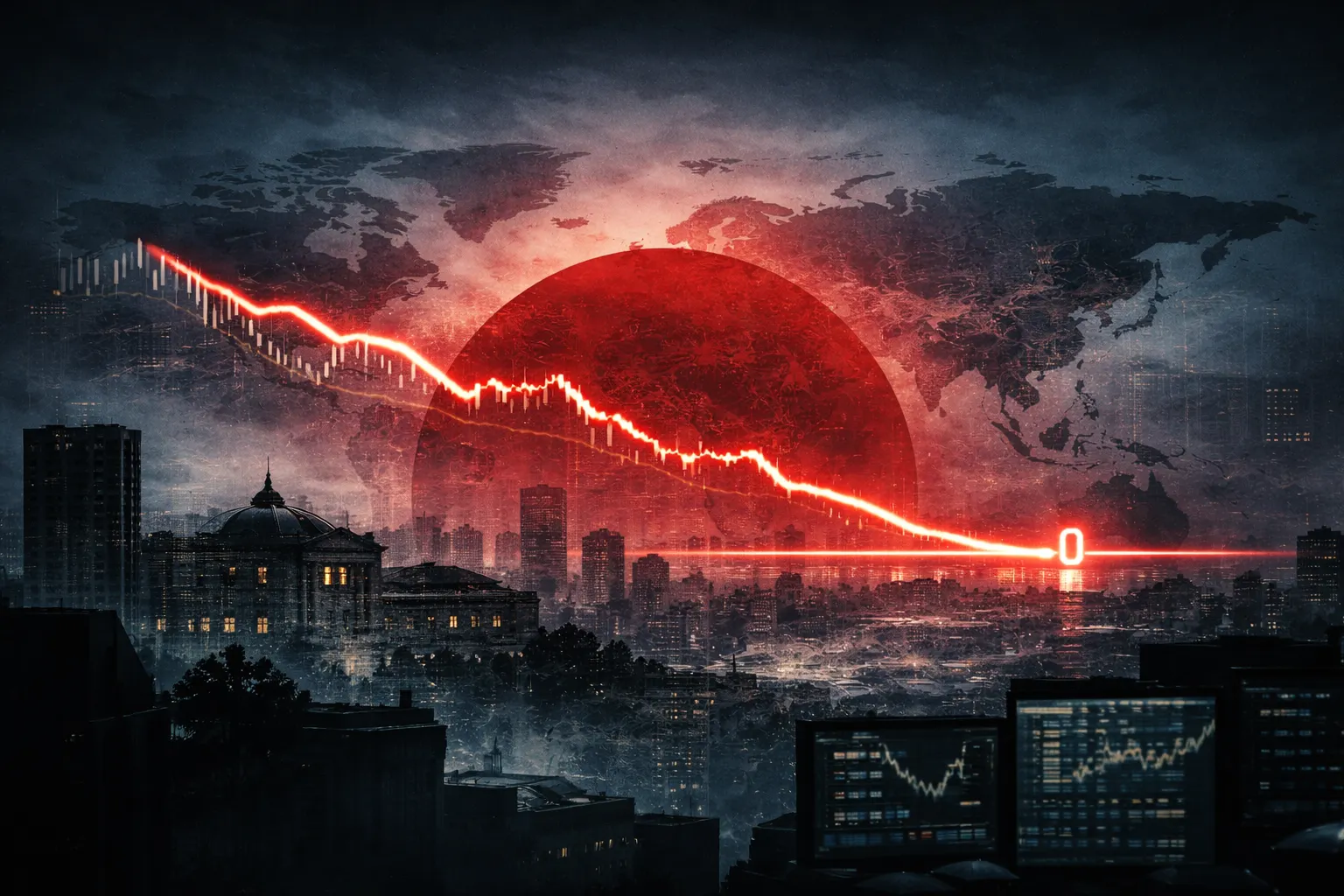
What starts as an emergency measure can easily become permanent.
The Bank of Japan says it will lower its key interest rate, the uncollateralized overnight call rate, "as low as possible" because the economy is stuck in a rut and prices are falling fast. In practice, almost none, with a final value of about 0.01–0.02 percent.
In Tokyo, the curtain is not falling in February 1999. Interest rates are going down very quickly.
At the time, people didn't see the decision as a turning point for the whole world. People think of it as a Japanese oddity, a last-ditch effort by a country that can't get out of its "lost decade." An experiment from Japan. Western economists and central bankers look on with detached interest, sure that their own economies are safe from such problems. But that moment marks the start of a new era, one in which cheap money is the norm instead of the exception.
From Miracle to Madness
To comprehend Japan's attainment of the zero bound, it is essential to revisit the post-war economic miracle. Japan rebuilt at an incredible speed after World War II, thanks to American reconstruction programs and a culture of disciplined industrial production. By the 1970s and 1980s, Japanese car companies like Toyota and Honda were beating Detroit, electronics companies like Sony and Panasonic were taking over markets all over the world, and Japanese money was flowing out of the country with amazing confidence. Rich businessmen were buying famous Western properties like Columbia Pictures in Hollywood, Rockefeller Center in New York, and the Pebble Beach golf course in California.
The late 1980s were the peak of this confidence. Land and stock prices in Japan started to rise in a parabolic way because of a volatile mix of loose monetary policy, deregulation of the financial sector, and a speculative frenzy. The Bank of Japan kept interest rates low until the middle of the 1980s, in part to make up for the strong yen that came after the 1985 Plaza Accord. The economy was flooded with cheap credit, and more and more of that money went into real estate and stocks instead of productive investments.
The numbers were shocking. Prices for commercial real estate in Japan's six biggest cities went up four times over the course of the decade. The value of all Japanese real estate was thought to be four times that of all US land, even though the US is twenty-five times bigger. People used to say that the grounds of the Imperial Palace in central Tokyo were worth more than the whole state of California. Land prices in Tokyo's upscale Ginza district were much higher than in Manhattan. A typical house near the capital costs more than $2 million. People paid amounts that could buy luxury homes abroad to get golf club memberships.
The stock market acted the same way. In the fifteen years leading up to the peak, the Nikkei 225 went up by more than 900%. The index went up about 9,000 points in 1989 alone, reaching an all-time high of 38,957 on December 29, the last trading day of the decade. The price-to-earnings ratios of Japanese stocks were close to 70, while the average for the rest of the world was between 15 and 20. Many businesses used "financial engineering," or zaitech, to borrow money at low interest rates and bet on rising assets. Some people think that at its peak, 40 to 50 percent of corporate profits came from risky investments instead of work that made money.
People who were living through it thought it would never end.
The Accident
Finally, the Bank of Japan, which had helped create the runaway asset inflation, slammed on the brakes. From May 1989 to August 1990, the discount rate went up from 2.5% to 6%.
The effect was quick and terrible. The Nikkei lost almost half of its value in a year, going from a high of about 39,000 to about 20,000 by the end of 1990. By August 1992, it had dropped to about 14,300, which was more than 60 percent lower than the highest point. The stock market kept going down, and by March 2003, the Nikkei had hit a post-bubble low of about 7,600, which was an 80 percent drop from its peak in 1989.
Real estate came next, but the damage was just as bad as it was in the past. In 1991, the prices of land for businesses and homes started to drop, and they didn't stop for more than ten years. In 2004, the price of residential land in Tokyo was about 10% of what it was at its peak in the late 1980s. In the most expensive parts of Ginza, prices fell to about 1% of what they were worth in 1989.
The damage spread throughout the whole financial system. Japanese banks had lent a lot of money against land that was quickly disappearing. Loans that weren't being paid back piled up. Instead of admitting losses, writing off bad assets, and quickly getting more capital, both banks and regulators went through a slow-motion crisis of denial. Lenders could put off paying for years because of accounting rules and regulatory leniency. Many banks that were technically bankrupt kept running, earning the nickname "zombie banks." Instead of giving credit to new, productive businesses, they only lent enough to keep "zombie companies" from going under.
People lost faith in the economy. The wealth of households disappeared. The economy stopped growing for a long time. And the most worrying thing was that prices didn't just stop going up; they started to go down. Japan went into deflation, which lasted for twenty years.
Into the Trap
Deflation is a sneaky economic problem that is much harder to get out of than the inflation that most policymakers are taught to fight. When prices keep going down, acting rationally can hurt the economy. People put off buying things because they think they will be cheaper tomorrow. Businesses put off investing for the same reason. The real cost of debt goes up even as borrowers have a hard time paying it back. Profits fall, wages stay the same, and a cycle that keeps going starts.
As the crisis got worse, the Bank of Japan slowly lowered interest rates throughout the 1990s. For example, the overnight call rate went from more than 8% in 1991 to 0.5% in September 1995. But the cost of borrowing wasn't the only issue. It was confidence—the mental paralysis of a whole country that had seen a generation's worth of wealth disappear.
Fiscal policy tried to fill the gap. The government kept putting money into public works and infrastructure with one stimulus package after another. Japan's national debt grew by a lot. But every time the government spent money, it only caused a short-term growth spurt. In April 1997, a premature increase in the consumption tax from 3% to 5% pushed the economy back into recession and caused a full-blown banking crisis that year.
Things had gotten worse by the end of 1998 and the beginning of 1999. Even though the economy was weak, long-term interest rates were going up. The yen was going up quickly, which was bad news for exporters. The CPI inflation rate was close to zero and could have gone negative. The BOJ's Policy Board, which had only recently become legally separate from the government in April 1998, was in a very difficult situation: they had almost run out of interest rate cuts, but the economy was still getting worse.
The choice was made in February 1999. The overnight call rate would drop to almost zero. In April, the Bank made a promise that had never been made before: the zero rate would stay in place "until concerns about deflation are put to rest." The Zero Interest Rate Policy, or ZIRP, was the name given to this combination of the zero rate and clear forward guidance about how long it would last. One member of the BOJ board later said that it was a unique experiment not only because of the rate level, but also because it involved a promise about the future course of monetary policy.
The Start of a Strange Monetary Policy
At first, the markets were a little skeptical. In the West, economists saw Japan as a warning story based on its own problems, such as an aging population, a weak banking system, structural inflexibility, and long-standing deflationary expectations. Most people thought that no modern Western economy would ever be in this situation.
The ZIRP did have some real effects on the financial markets. The yield curve got a lot flatter, and rates on instruments with maturities of less than a year fell to almost zero for most of 1999. The yield on a ten-year Japanese government bond stayed between 1.6 and 2.0 percent. The prices of stocks went up a little bit. But the real economy stayed weak, and deflation wouldn't go away.
In August 2000, the BOJ made what is now widely seen as a bad and premature choice: it raised the overnight rate to 0.25 percent based on false hopes of growth. The dot-com bust was going on all over the world, Japan's tech exports were falling, and the economy quickly fell back into recession. By March 2001, the BOJ had to make an embarrassing change: it lowered rates back to zero and went even lower this time.
The Bank of Japan officially started quantitative easing (QE) on March 19, 2001. The target for the operation changed from the interest rate to the balance of current accounts at the BOJ, which was set at 5 trillion yen (well above the required reserves of about 4 trillion yen, which effectively guaranteed a zero interbank rate). The Bank started buying government bonds directly, starting with 400 billion yen a month and going up to 1.2 trillion yen a month by October 2002. The promise was made more clear than it was in 1999: QE would keep going "until the consumer price index stays above zero percent year after year."
Japan had become a place where monetary experiments were done that no other major economy had tried since the Great Depression of the 1930s. The whole set of tools that Western central banks would later use, like forward guidance, quantitative easing, balance-sheet expansion, and asset purchases, were first created, tested, and improved in Tokyo.
The Time of Global Transmission
For almost ten years, the rest of the world watched Japan's problems with a mix of sympathy and indifference. People in academic seminars talked about "Japanification" as a possible risk, not a real threat.
Then came the year 2008.
The failure of Lehman Brothers in September of that year, the collapse of the U.S. housing market, and the panic that spread through global credit markets changed everything. Japan's playbook, which it had been writing for years, suddenly became very important.
The Federal Reserve cut interest rates sharply, bringing them down to zero by December 2008, about eighteen months after the crisis first started in August 2007. As soon as the Fed hit zero, it used the unusual tools it had learned about from Japan's experience. The Federal Reserve's balance sheet grew from less than $1 trillion to more than $4.5 trillion thanks to large-scale asset purchase programs, which are also known as QE1, QE2, and QE3. Forward guidance—clear promises about where rates will go in the future—became a key part of policy communication, thanks to the BOJ's earlier ideas.
The Bank of England did something similar: it cut rates to 0.5 percent in March 2009 and started its own QE program. In 2009, the European Central Bank, which was initially more cautious, started buying covered bonds. In 2010 and 2011, they also bought sovereign debt from eurozone countries that were having trouble. But it was Mario Draghi's famous promise in July 2012 to do "whatever it takes" to protect the euro that really showed that Europe had fully adopted the Japanese model. The ECB started a full asset purchase program of €60 billion per month (later raised to €80 billion) in January 2015. In June 2014, it became the first major Western central bank to lower interest rates to negative levels.
People were no longer afraid of "Japanification" in school. It was the way things really were in the biggest economies in the world. Bond yields in Europe and the US fell to levels that would have been unthinkable a generation ago. The yields on German 10-year Bunds went negative. At the same time, the central banks of Switzerland, Sweden, Denmark, and Japan all had negative policy rates. During the worst of the negative-rate period, about $18 trillion worth of bonds around the world were trading at yields below zero. This meant that investors were basically paying governments to lend them money.
The 1999 experiment had become the norm by 2015.
The Side Effects
Experiments, especially those executed on a civilizational scale, often yield outcomes unforeseen by their architects. The time of ultra-cheap money kept economies stable and stopped terrible deflationary spirals. But it also changed the way the global financial system worked in a big way, and not always for the better.
Getting into debt. When borrowing costs are very low, there is a strong reason to do so. And everyone did borrow. The ratio of government debt to GDP rose sharply in all developed countries. Japan's own public debt, which was already huge before ZIRP, rose to more than 250% of GDP, the highest of any major economy. The national debt of the United States grew by 100% from 2008 to 2020. Corporate debt also grew quickly, but a lot of it didn't go toward capital investment and R&D; instead, it went toward share buybacks and financial engineering, which is a painful echo of Japan's zaitech era.
Inflation of asset prices. When risk-free rates were at or below zero, investors had to look for riskier and riskier assets to get returns. This is what central bankers call the "portfolio balance channel," and regular people see it as housing becoming too expensive. Stock markets hit all-time highs. Prices for real estate in big cities all over the world went through the roof. As yields fell, bond prices went up. The wealth effect was real, but it wasn't spread out evenly.
Growing inequality. This was probably the most important side effect for politics. In a monetary accommodation regime, asset prices always rise faster than wages. This means that people who own assets benefit more than others. Homeowners' property values went up, but renters' costs went up too, without the gain. Stockholders got richer, but workers who didn't have stocks didn't. Monetary policy, which was supposed to be a technocratic job done by independent central banks, became a cause of the inequality that made people angry in the West.
Financial instability. Markets became dependent on help from the central bank. Any hint that the money supply might be cut off led to big sell-offs. The "taper tantrum" of 2013 was the most dramatic early example. When Fed Chairman Ben Bernanke suggested that bond purchases might be cut back, global markets went crazy. The system had become dependent, which made it dangerous to leave.
Japan had given a warning. People didn't listen right away.
The Irony of the Exit
For a long time, people thought Japan was stuck, like an economy that couldn't get away from its own stagnation. But after the COVID-19 pandemic and the worldwide inflation that followed, things changed in a strange way. The Western economies had to deal with the same problem that Japan had been trying to solve for decades: prices going up.
Inflation in the United States reached levels not seen since the early 1980s because of problems with the supply chain, huge government spending, pent-up consumer demand, and the energy shock from Russia's invasion of Ukraine. In June 2022, the Consumer Price Index reached its highest point at 9.1 percent. Europe went through something similar. Central banks that had been at the zero bound for more than ten years made a quick turn and raised interest rates at the fastest rate in decades. In less than eighteen months, the Federal Reserve raised its benchmark rate from almost zero to more than 5%. The ECB raised its deposit rate to 4 percent, even though it had been at negative rates just a few months before.
The time of "free money" came to an end suddenly and shockingly, but not in Japan.
Japan was the last major economy to still have an ultra-loose policy, which is very ironic. The BOJ stuck to its negative interest rate and yield curve control framework, even though the rest of the world was tightening like crazy. Japan's central bank finally raised rates on March 19, 2024, from -0.1% to a range of 0% to 0.1%. This ended the last negative interest rate policy in the world. There were seven votes for and two against. Governor Kazuo Ueda talked about the move carefully, saying that the economy had "moderately recovered" and that wage growth—thanks to the 2024 Shunto spring negotiations, which resulted in the largest agreed wage increases in 33 years—gave him confidence that wages and prices were starting to rise in a good way.
The BOJ also stopped buying exchange-traded funds and real estate investment trusts and stopped using its yield curve control framework. This effectively ended the complicated system of unconventional easing that had been built up over the past 25 years. There were more rate hikes after that: to 0.25 percent in the middle of 2024, to 0.5 percent by the end of the year, and finally to 0.75 percent in December 2024, the highest level since 1995. As of early 2026, BOJ officials say that the normalization process is still going on. Inflation has been above 2% for almost four years in a row, and the IMF says it will go up even more.
The experiment that started in February 1999 is coming to an end, but slowly and carefully, in a world that Japan would barely know.
The Lesson of 1999
The tale of zero interest rates is not just a technical story about central banking. It's the story of an economy that tried to get over a huge loss of trust with tools that had never been used on such a large scale before. A decade later, when the same thing happened again, the world used the same tools without fully understanding the lessons learned from Japan's experience.
Japan showed that when demand falls and deflation sets in, normal monetary policy isn't enough. It was the first to use forward guidance, quantitative easing, yield curve control, and negative interest rates. The Federal Reserve, the European Central Bank, the Bank of England, and others would later use these ideas as well. If Japan hadn't gone through decades of painful experimentation, the world would have reacted to the 2008 crisis more slowly, more roughly, and possibly much more destructively.
Japan also showed what happens when you keep interest rates low for a long time. Bubbles in assets. Banks and companies that are like zombies. Growing public debt. Growing inequality. A financial system that relies on the very emergency measures that were put in place to save it. And most importantly, the problem of getting out of extraordinary policy without causing the crisis you were trying to avoid.
The choice made in February 1999 wasn't the only one. It was the first chapter of a time that changed how markets think about time, risk, and the cost of money in a big way. For 25 years, the world lived in the shadow of that Japanese experiment. At first, it was ignored, then copied, and now, slowly but surely, it is trying to move on.
In a world that is trying to bring interest rates back to normal, the Japanese example teaches us a simple but important lesson: what starts out as an emergency measure can quickly become permanent. And the longer it lasts, the harder it is to get over.