The Judge Told Them to Paint — And in 53 Minutes, a 30-Year Lie Collapsed
The woman who painted locked in a basement. The man who became famous for her works. And the moment a judge said, "Paint. Now."
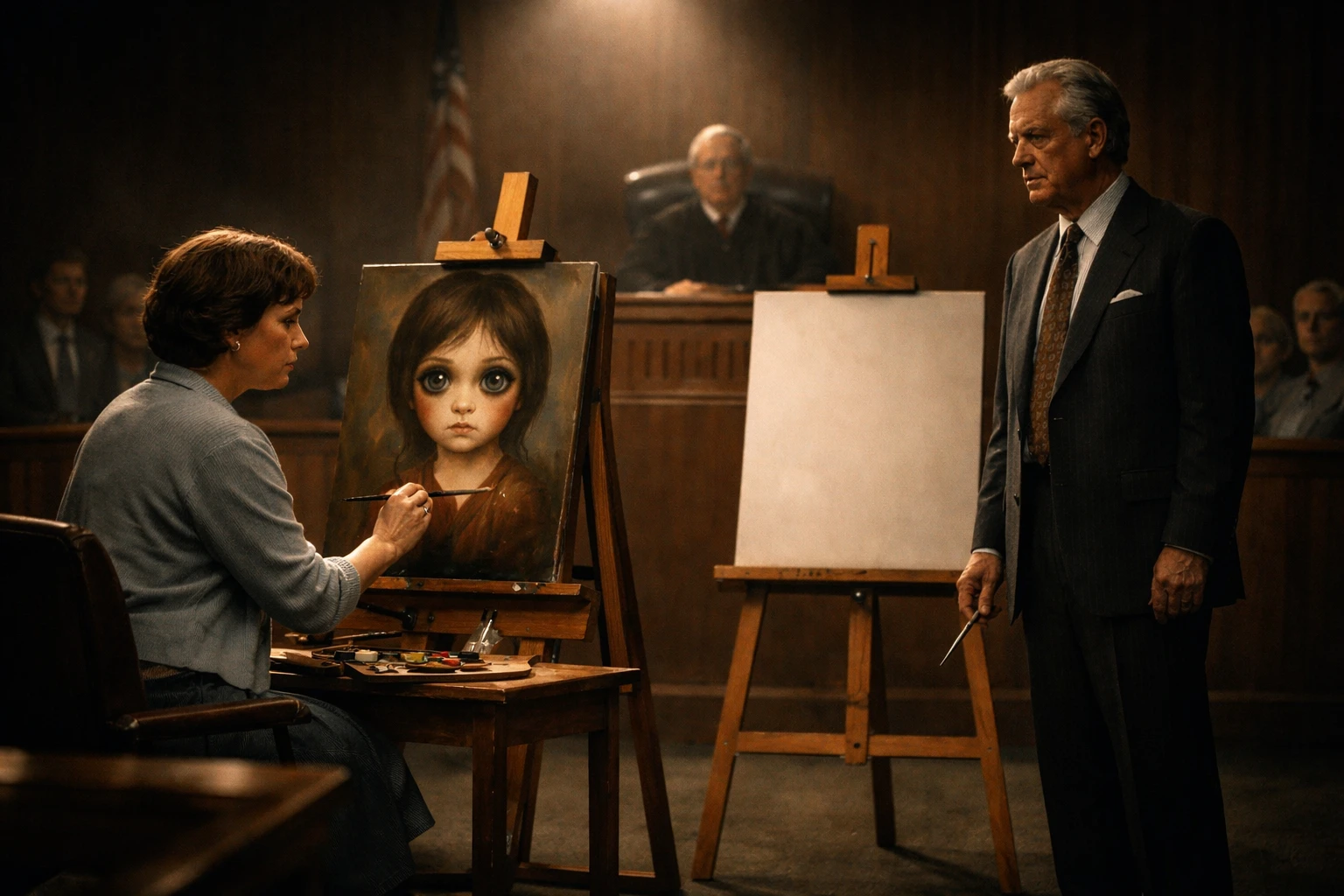
1986 in Honolulu. A federal courtroom is quiet. In front of the jury, there are two easels.
The judge has had enough of the accusations between the two sides. Both have claimed to be the authors of the famous "big-eyed children" portraits, which are haunting and sad and became one of the most commercially successful art movements of the twentieth century. The judge decides that the answer is painfully simple: "Paint here." In front of us.
Margaret Keane takes up the brush. Walter Keane stays still.
Fifty-three minutes later, she has finished another painting with those big, piercing eyes that are so typical of her work. Later, the work would be put in the catalog as Exhibit 224. He hasn't even touched the canvas yet. He says his shoulder hurts, but it's the same shoulder that never stopped him from lifting drinks at celebrity parties or posing for pictures with five brushes in his hand. A lie that lasted for thirty years has finally come to an end.
The Eyes Before the Storm
The story doesn't start in a courtroom or a gallery. In 1927, a girl named Margaret Doris Hawkins is born in Nashville, Tennessee, to a poor family. When she was two years old, a mastoid operation permanently hurt one of her eardrums. Because she can't hear well, young Margaret starts a habit that will shape her life and her art: she learns to watch people's eyes closely and read their emotions and meanings to make up for what she can't hear.
She starts drawing when she is young. At ten, she is going to school at the Watkins Institute in Nashville. She finishes her first oil painting, which is of two little girls, one crying and one laughing. She gives it to her grandmother. She is eighteen and goes to the Traphagen School of Design in New York City. She is talented, disciplined, and has a unique vision. She says that she doesn't have confidence. She says she is very shy and timid, which will keep her from getting recognition for decades.
Margaret moves to San Francisco in the early 1950s after her first marriage ends in divorce and gives birth to a daughter named Jane. She makes a living by painting baby cribs and clothes. She sells charcoal drawings and small portraits at outdoor art shows. Around 1953, she meets a man at one of these shows who will change everything.
The Lovely Thief
Walter Stanley Keane is born in Lincoln, Nebraska, in 1915. He is the tenth child. He used to be a real estate agent and is very charming and driven. He acts like an artist, but his actual creative skills are, at best, very small. He studied art for a short time in Paris and says that seeing orphaned children with huge, haunted eyes digging through the rubble of Berlin after World War II in 1946 inspired him. It is a vivid and emotionally powerful backstory. It is also, like almost everything else about Walter Keane, the truth of someone else that he has made into his own.
Margaret thinks he is charming, smooth, and friendly. In 1955, they get married in Honolulu. He is good at selling things. She has a knack for making things. It looks like a great partnership on the surface.
What happens next is not a partnership or a collaboration. It's a crime.
The Hungry i and the Start of a Trend
Walter starts selling Margaret's paintings at the hungry i, a famous beatnik nightclub on Jackson Street in San Francisco, not long after the wedding. This is where comedians like Lenny Bruce and Bill Cosby used to perform. Walter moves around the room with the ease and confidence of a natural showman, shaking hands and selling paintings until last call. The works are signed with the name "Keane," which is a common last name that is used to trick people.
Margaret goes with him to the club one night. A stranger walks up to Walter while she is talking to buyers about her paintings and politely asks, "Do you paint too?"
The shock is right away. At that moment, she knows that her husband is taking credit for what she did.
He has a quick answer when she confronts him at home: they need the money. People are more likely to buy from a man. They wouldn't want to know that he can't paint and has to ask his wife to do it. People will be confused and start suing if he suddenly tells the truth. He knows how to market. Not her. The logic is meant to sound useful, even protective. What it really does is start a decade of erasure.
At first, she agrees with it. Then the success goes way beyond what either of them could have imagined.
A Lie Built an Empire
The Keane paintings are everywhere by the early 1960s. The big-eyed kids, who are sad and have big, glowing eyes, become a cultural phenomenon. Prints are made in large numbers. Mugs, greeting cards, plates, and posters all have reproductions on them. They sell a lot of them. The Keanes make more than two million dollars a year, which is about nineteen million dollars today.
Walter, who is playing the part of an artistic genius, is on TV. He talks in a flashy way during interviews. He thinks he is like El Greco and Modigliani. Joan Crawford, Natalie Wood, Kim Novak, Jerry Lewis, and Dean Martin all buy original works. There is a picture of Caroline and John-John Kennedy in the White House. In 1961, the painting Our Children is given to UNICEF and becomes part of the United Nations' permanent art collection.
There are galleries on Madison Avenue in New York and on the streets of San Francisco. Columnists in the newspaper call Walter "my friend" and write about his adventures with great excitement. He throws fancy poolside parties where the Beach Boys and Hollywood stars come to see him. He talks about the affairs and the three women who wait for him in bed at night in his own memoir. He is the toast of the art world, or at least the commercial art world.
And through it all, Margaret keeps painting.
She paints in a locked studio with the curtains drawn for up to sixteen hours a day. No one is allowed in, not even their daughter or the people who work for them. Walter calls every hour to check on her if she leaves the house. He follows her if she does slip away. She doesn't see the famous people who swim in her pool very often. She is the most successful painter in America when it comes to making money, but no one can see her.
At one point, Margaret tried to show Walter how to paint the big-eyed kids himself. He wasn't able to do it. Not even close. His job was to be a parasite: he took her work, sold the goods, and enjoyed the fame.
Tomorrow Forever: The Top and the Bottom
In 1963, Margaret paints what Walter will call his "masterwork." The name of the painting is "Tomorrow Forever." It is a huge oil painting that is about four by eight feet and shows about one hundred big-eyed children of different races standing in a line that goes to the horizon, like refugees in an empty world. The painting is chosen to be the main piece of art for the Hall of Education at the 1964 New York World's Fair.
Then the critics come out. John Canaday, the art critic for The New York Times, gives a scathing review, calling Keane a painter known for making formulaic pictures with such terrible sentimentality that his work has come to mean the very definition of tasteless hack work. Canaday says that the painting has about a hundred kids in it, which makes it about a hundred times worse than the average Keane.
The powerful president of the World's Fair, Robert Moses, moves quickly. He takes the painting down before it is ever shown, saying it is a case of very bad taste and low standards.
For Margaret, this rejection of her most ambitious work, which she poured out in secret and under duress, may have been one crack too many. She leaves Walter in 1964. She moves to Hawaii with her daughter. The divorce is final in 1965.
The Getaway
Hawaii has more to offer Margaret than just geography. It gives her the room to start over. She becomes a devout Jehovah's Witness and says that her new faith and reading the Bible gave her the strength to finally tell the truth. In 1970, she meets and marries Dan McGuire, a sportswriter from Honolulu. She says that he helped her get over the shyness and fear that Walter had used against her for ten years.
But the lie lives on. Walter continues to claim authorship. He keeps selling. And Margaret's name is still not on her own work.
Margaret finally speaks up in 1970 during an interview on a Hawaiian radio show. She tells the world what had been kept secret for more than ten years: she painted all of the big-eyed kids. Everyone.
The reaction is like a volcano. Walter, as expected, gets angry. He tells a UPI reporter that Margaret is a "boozing, sex-starved psychopath." He tells everyone who will listen that she is crazy, a liar, and needs attention.
Margaret dares people to a public paint-off in Union Square in San Francisco. Let them both set up easels outside and paint. The world can then decide for itself. Bill Flang, a reporter for the San Francisco Examiner, is in charge of putting on the event. The media comes down. Margaret shows up and paints one of her famous works for a big crowd. Walter never comes.
The fight continues, though, because there is no clear legal solution. Walter still says he owns the paintings. People all over the world are left to wonder.
The Courtroom in 1986
Sixteen years go by. In the middle of the 1980s, USA Today publishes an article in which Walter Keane once again says he is the real artist. He says that Margaret only says she wrote it because she thinks he is dead.
Margaret has had enough. In Hawaii, she is suing Walter and USA Today in federal court for slander. She doesn't want any money. She wants the truth to be written down.
The trial lasts for three weeks. Walter, in a typical show of ego, acts as his own lawyer and questions himself on the witness stand. A judge is said to have threatened to put duct tape over his mouth. For her part, Margaret brings a few of the original paintings into the courtroom. The people who were actually in the portraits, the witnesses, say that they posed for her. Walter doesn't bring any of those paintings because, as Margaret's lawyer says, they don't exist.
Then comes the time that will end the argument for good.
The judge can't figure out who is telling the truth just by listening to their testimony, so he tells both Margaret and Walter to paint a picture in front of the jury right then and there. He says it's the easiest and best way to show who made those big eyes.
Margaret is sitting in front of the canvas. Six jurors watch her work quietly and steadily, as if she were in her own studio. The painting is done in fifty-three minutes. It's of another child with those big, bright, unmistakable eyes.
Walter doesn't make anything. Not a sketch, a drawing, or a painting. He says that his sore shoulder stops him from painting.
After three weeks of testimony, the jury gives Margaret four million dollars in damages, which is about twelve million dollars today. Later, a federal appeals court agrees with the defamation verdict from 1990 but throws out the money award. There is no appeal for Margaret. The money doesn't matter to her.
She says, "The money didn't matter to me." "I just wanted to make sure everyone knew I did the paintings."
And the Love of the People
The art world never fully accepted Margaret Keane. Critics said the big-eyed kids were sentimental kitsch, like greeting-card art, or like seeing too much sugar. Many people in the gallery world felt the same way about John Canaday as he did about her. They saw her as the opposite of the abstract expressionism and pop art that were the main topics of serious art talk.
But the people loved her. They always did. And not all of the people in the art world were against it. Andy Warhol, the man who made a fortune by mixing business with art, gave his opinion in a 1965 interview with Lifemagazine. He thought the work was great and said that if it were bad, so many people wouldn't love it. This was not faint praise coming from the father of pop art.
Hollywood stars like Joan Crawford, Natalie Wood, Jerry Lewis, Liberace, Zsa Zsa Gabor, and Robert Wagner had their portraits painted. There used to be a painting of Kennedy family children with Keane eyes in the White House. The influence went beyond fine art. For example, the animated TV show The Powerpuff Girls, which started in 1999, had three characters with very big eyes that were directly inspired by Keane's style. There was even a teacher character named Ms. Keane.
Margaret's art changed after the trial. The children she painted while she was a prisoner had dark backgrounds, sad settings, and eyes full of silent pain. But as time went on, the colors got brighter and the moods got softer. A lot of galleries started to say that her later works showed "tears of joy" instead of "tears of sorrow." She called her new subjects "children in paradise," which was how she thought the world could be.
Large Eyes
Tim Burton, a long-time fan of Keane's art, made Big Eyes in 2014. It was based on her life. Amy Adams played Margaret and won a Golden Globe for it. Christoph Waltz played Walter with a lot of bravado. The people who made the movie copied almost two hundred of Margaret's original works. Adams met with Margaret in person to learn about her creative process and her calm, strong personality.
Watching the movie made Margaret very emotional. But it did something she had been fighting for for decades: it told her story to a new generation.
Walter Keane never told the truth. He spent his last years writing and rewriting an unpublished memoir called The Real Love of Walter Keane. People who read it said it was an amazing mix of sexual bragging, mystical messages from the dead, and incredibly delusional self-inflation. He said in one part that Michelangelo had come to him in a vision to put him in an "Elysian Gallery of Artistic Immortals." He died on December 27, 2000, in Encinitas, California, at the age of 85. He still said the paintings were his.
The Name on the Canvas
In 1991, Margaret Keane went back to California and ran the Keane Eyes Gallery in San Francisco, which has the biggest collection of her art in the world. She kept painting even when she was in her nineties. She went into hospice care at her home in Napa County in 2017, when she was 90 years old. She lived there with her daughter Jane and son-in-law.
On June 26, 2022, she died of heart failure at the age of 94.
For years, her kids' big eyes looked out at the world as if they wanted something—maybe justice or just to be seen. She won both times in fifty-three minutes in a Honolulu courtroom. And she got back something more valuable than money, fame, or praise from critics.
Her name. About her own work.
The painting she made that day, Exhibit 224, was never copied in any way while she was alive. The Keane Eyes Gallery released only 224 signed and numbered prints and 26 artist proofs after her death. They were gone almost right away.
It turned out that the eyes had been watching all along.