Why East Germans Regret Reunification?
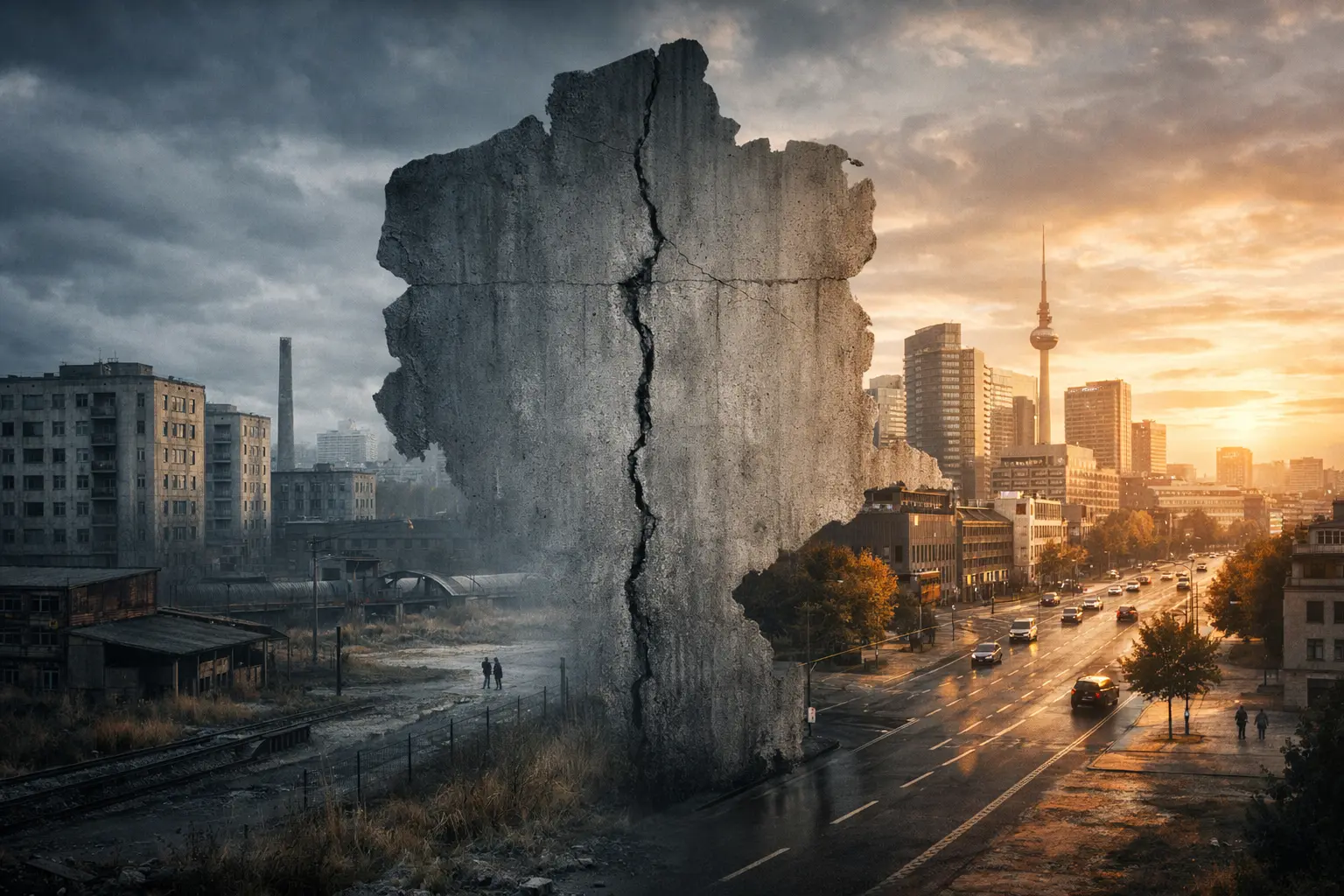
More and more residents of the former German Democratic Republic are expressing dissatisfaction with the 1990 reunification with West Germany, as they feel like second-class citizens—something that is also reflected in the numbers. However, East and West agree on issues of democracy.
Decades of oppression, post-war poverty, life under the watchful eye of the notorious Stasi, and the long arm of Moscow had created an Orwellian reality in the German Democratic Republic (Deutsche Demokratische Republik, DDR), a reality that in 1990 made the reunification of Germany more than welcome for millions of East Germans.
The process had begun on 9 November 1989, when the Berlin Wall fell after Hungary's removal of its border fence with Austria opened a hole in the Iron Curtain, triggering an exodus of thousands of East Germans fleeing west. The Peaceful Revolution, a series of massive civic protests in cities like Leipzig and Dresden, culminated in the GDR's first free elections on 18 March 1990 and, ultimately, formal reunification on 3 October 1990, a date now celebrated annually as German Unity Day (Tag der Deutschen Einheit). In the months surrounding unification, around 750,000 East Germans migrated west, seeking higher wages and better opportunities.
In the decades that followed, despite the economic inequalities they experienced in relation to the developed western part of the country, most East Germans felt it had been worth it. But this view has begun to lose popularity. The annual government report Deutschland Monitor, on the state of the German nation, published in late 2024, shows a sharp increase in the number of citizens of the former GDR who believe that reunification did them more harm than good.
Rising Dissatisfaction by the Numbers
According to the report, 37% of East Germans now believe that the union of their former country with the Federal Republic of Germany has had more negative than positive effects. Two years ago, the corresponding figure was only 26%. This represents the highest level of dissatisfaction since the turbulent early 1990s, when the immediate economic shock of reunification was at its most severe.
The poll shows consistency across all generations, according to the Social Research Center (Sozialforschungszentrum) in Halle, a city in former East Germany, one of the organizations that worked on the survey. Skepticism is even higher in lower-income areas, where opinions are almost evenly divided: 46% believe reunification has had an overall negative impact, while 49% say its advantages outweigh its disadvantages.
This dissatisfaction is growing alongside support for the far-right Alternative for Germany (AfD) party, which has become the most popular political force in the East and is leading in the polls ahead of elections in the states of Saxony-Anhalt and Mecklenburg-Western Pomerania. In recent regional elections across eastern Germany, the AfD has surged to become the dominant party in several states, challenging the long-standing political consensus from Berlin. Analysts have noted that the resentment of elites, stemming from the top-down economic shock therapy imposed by the West, has spurred a populism more easily co-opted by the right wing than the left.
The Economic Paradox
At first glance, this is a puzzling set of findings, especially since East Germans are experiencing the best economic situation in their history.
At the end of the Cold War, as the extremely uncompetitive state-owned industries of the GDR were dismantled and their assets passed to Western investors, average incomes in the East were only 40% of those in West Germany. Their current incomes have risen to approximately 80% of those of their Western compatriots. If we also take into account the slightly lower cost of living in the East, the gap becomes even smaller. Recently, economic growth has been considerably stronger in the East than in the West.
Former East Germans are well aware of these improvements. Seventy-three percent say they have personally gained more from reunification than they have lost, while only 19% believe the opposite. This reflects a broader paradox in German society: surveys consistently show that Germans are generally optimistic about their individual circumstances but pessimistic about the country as a whole.
This is partly because most Germans are concerned with things beyond the amount of money in their bank accounts. But the numbers also carry a sting. East German wages still lag roughly 20–25% behind Western levels. East Germans inherit only about half as much wealth as Westerners—a direct consequence of the way reunification transferred nearly all productive assets into Western hands. Household wealth in the West remains roughly twice as high as in the East. As of 2020, fewer than 10% of Germany's major corporations were headquartered in eastern states, despite the region accounting for about 17% of the population. Impose almost any economic indicator onto a map of Germany, and the old East-West border reappears.
The Treuhand Legacy: Economic "Colonisation"
Much of East German bitterness traces back to the Treuhandanstalt (Trust Agency), the government body created in 1990 to privatize the GDR's state-owned economy. The Treuhand inherited approximately 8,500 enterprises employing over four million workers—the largest industrial portfolio ever placed under a single agency. Its motto, as articulated by its president Detlev Karsten Rohwedder, was to "privatize quickly, restructure resolutely, and shut down carefully."
The process was swift and devastating. Of the more than 8,000 companies it handled, roughly 60% were sold off to private buyers and approximately 30% were liquidated outright. By 1995, when the Treuhand concluded its main activities, 51% of the privatized firms, 64% of turnover, and 68% of jobs in the sample had passed to West German investors. The most productive East German companies were rarely sold to East Germans; over 80% of privatized enterprises ended up in the hands of West German or international investors. Some enterprises were sold for the symbolic price of a single Deutsche Mark. Many were subsequently closed or drastically downsized by their new owners. In total, 2.5 million employees in state-owned enterprises, out of four million, were laid off during the early 1990s.
The currency conversion accelerated the disaster. The one-to-one exchange of East German Marks to Deutsche Marks, politically popular but economically reckless, ignored the GDR's roughly 70% productivity gap. Overnight, East German products became uncompetitively expensive. Industrial production collapsed, falling 73% from 1989 levels. East German consumers, meanwhile, rushed to buy Western cars, refrigerators, and branded goods, abandoning the domestic products they had used for decades.
The Treuhand itself ended as a financial catastrophe, accumulating between 260 and 270 billion Deutsche Marks in debt, equivalent to roughly $350 billion in today's terms. On 1 April 1991, its chairman Rohwedder was assassinated, possibly by the Red Army Faction. The agency was formally dissolved on 1 January 1995, but its toxic legacy endures as a symbol of deindustrialization, dispossession, and what many East Germans experienced as an economic "colonization" rather than a fraternal integration.
Brain Drain, Demographic Crisis, and Lost Identities
The economic upheaval triggered a demographic catastrophe. After 1990, four out of five eastern Germans lost their jobs or had to change their workplaces. This was all the more traumatic because unemployment had been virtually nonexistent in the GDR, where the right to work was enshrined in the constitution. By the end of the 1990s, unemployment in the former GDR had reached nearly 20%, and in states like Thuringia it remained above 16% for the decade between 1996 and 2005.
Between 1989 and 2006, approximately 1.8 million people—overwhelmingly young and skilled—left eastern Germany for the West. Birth rates in the East plummeted. Entire communities hollowed out. The state of Thuringia lost 7% of its population in the first decade after reunification alone. Towns like Saalfeld, which had 32,349 inhabitants in 1994, fell below 25,000 by 2016. This brain drain created a vicious cycle: the ambitious left, reducing opportunities for those who stayed behind, which in turn drove more departures.
Women were hit disproportionately hard. The GDR had one of the world's highest rates of female workforce participation, supported by a comprehensive state-funded childcare system. Reunification dismantled many of these structures. Women lost their jobs at higher rates and found fewer replacement opportunities in the new market economy.
East Germans didn't just lose their jobs—they lost their products, their institutions, and much of their cultural identity. GDR-era restrictions on Western goods had produced distinctly East German versions of nearly every consumer product. After reunification, these vanished from shelves. The resulting nostalgia became known as Ostalgie, a portmanteau of Ost (East) and Nostalgie (nostalgia), a cultural phenomenon famously explored in the 2003 film Good Bye, Lenin! East Germans were well aware of the GDR's repressive nature, but many still found themselves missing the relative simplicity and security of their former lives.
Second-Class Citizens
The numbers tell a bleak story of exclusion from the corridors of power. Former East Germans, who make up 20% of the German population, hold only 13% of positions in public administration—dropping to just 6.8% at the highest leadership levels. They occupy a mere 4% of the most powerful positions in the business world, 2% of the judiciary, and not a single position in the country's senior military hierarchy.
Angela Merkel, who spent the first 35 years of her life in the German Democratic Republic and took her first steps as a politician there, served as chancellor of reunified Germany for 16 years (2005–2021). But she remains the overwhelming exception. Two-thirds of former East Germans report feeling like second-class citizens in reunified Germany—a sentiment that reflects far more than just an economic lag.
Experts point to a constellation of factors responsible for this persistent divide: demographic changes depopulating entire regions, declining infrastructure, the consequences of successive economic crises, rising inflation, uncertainty in the labor market, and the systematic exclusion of former East Germans from access to top institutional positions, especially in structurally weaker regions. There is also the lingering psychological wound of what researchers call a "recognition deficit": the feeling that East Germans' life achievements, professional experience, and cultural heritage were dismissed as worthless by the West. Some scholars have argued that concrete measures to address this, such as preserving valuable East German institutions like the comprehensive childcare system or workplace-based social services, could have substantially reduced the alienation.
It is often argued that the imprint of the old border between the two Germanys is still visible on almost every political, economic, or sociological map of the country. Germans themselves speak of the Mauer im Kopf, the "wall in the head", a psychological barrier that persists decades after the physical wall came down. Ossis (Easterners) are stereotyped as backward, poor, and influenced by Russian culture; Wessis (Westerners) are seen as arrogant, materialistic, and condescending.
The Russia Factor
The East-West divide extends to foreign policy. East Germany retains a distinct sympathy for Russia, shaped by decades of Soviet ties and reinforced by disappointment since reunification. Many East Germans remember the Soviet presence not merely as a geopolitical imposition but as a source of stability and, in some cases, personal connection. This lingering affinity affects contemporary politics: East Germans tend to be less supportive of arming Ukraine or imposing harsh sanctions on Russia, and they are more open to the idea of territorial concessions for peace, positions that put them at odds with the political mainstream in Berlin and the broader West.
Convergence Beneath the Divide
Yet the Deutschland Monitor study, based on interviews with 8,000 citizens across Germany, suggests that East and West are actually converging in some unexpected ways.
On both sides, attitudes toward the waves of change sweeping the country follow a strikingly similar pattern: about 25% of the public is ready to embrace them, another 25% tends to resist them, and the remaining half appears essentially uncertain and ambivalent. Both parts of the country have roughly the same levels of social cohesion, with clear majorities believing that their neighbors tend to help each other.
At the same time, both East and West continue to support the idea of parliamentary democracy, although 48% of former East Germans say they are dissatisfied with the way it works in practice, compared with 38% of former West Germans. The report categorizes 51% of former East Germans as "satisfied democrats," 22% as "politically critical democrats," 26% as "democrats who are critical of the system," and 2% as "anti-democrats." The corresponding percentages in western Germany do not differ significantly.
Academic research adds nuance to this picture. A study using over 419,000 observations from the German Socio-Economic Panel (SOEP) found that objective circumstances and subjective attitudes ("mentalities") contribute to the life satisfaction gap between East and West in roughly a 55:45 ratio. The mentality-related gap is driven primarily by birth cohorts who were socialized under the separate political regimes during the division period. Crucially, no satisfaction gap is detectable in cohorts socialized entirely in reunified Germany—suggesting that, slowly, the psychological wound may be healing.
A Reunification Still Unfinished
All this leads us to conclude that the bitterness of former East Germans is, to a considerable extent, understandable after 35 years of painful adjustment to the capitalist model of development, the dominant Western media, and the general feeling that the elites have little interest in their perspective. The reunification of 1990 was, in some respects, less a merger of equals than what some scholars have bluntly characterized as an annexation—the absorption of the DDR into the Bundesrepublik, with eastern Germans receiving subordinate treatment from day one.
Chancellor Helmut Kohl's promise of "flourishing landscapes" in the East became a bitter punchline. The Treuhand's ruthless efficiency left behind deindustrialized wastelands. The brain drain hollowed out communities. And even as material conditions have improved markedly, the sense of being overlooked, underrepresented, and culturally dismissed by the West persists.
Some historians express astonishment at how rapidly the process of reunification progressed given the enormity of the economic and social imbalances in 1990. But what matters more than the speed of reunification is how uneven and inequitable it remains. If East Germans had not felt—rightly so—that for too many years all decisions were made by and for West Germans, less estrangement would likely have resulted.
Thirty-five years on, the wall is gone. But the Mauer im Kopf endures, and true reunification remains a work in progress.